
Review the key concepts, formulae, and examples before starting your quiz.
🔑Concepts
The area of a rectangle is the measure of the total surface or space enclosed within its four boundaries. It is calculated by finding the product of its length and its breadth.
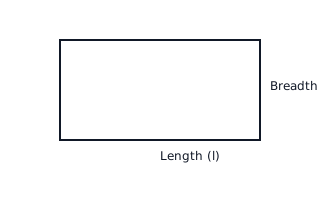
The units of area are always expressed in square units, such as , , or . To ensure a correct calculation, the length and breadth must be in the same unit of measurement before multiplication.
The diagonal of a rectangle divides it into two congruent right-angled triangles. If the area is unknown but the diagonal and one side are given, Pythagoras theorem () can be used to find the missing dimension.
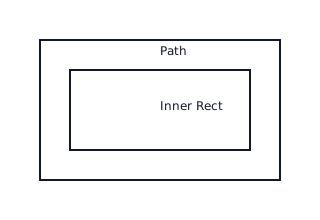
When calculating the area of a path around a rectangular field, the total area is found by subtracting the area of the inner rectangle from the area of the outer rectangle (Inner area = ; Outer area = where is the path width).
📐Formulae
💡Examples
Problem 1:
Calculate the area of a rectangular park whose length is and breadth is .
Solution:
Explanation:
Substitute the given length () and breadth () into the standard area formula for a rectangle.
Problem 2:
The diagonal of a rectangle is and its breadth is . Find its area.
Solution:
First, find the length () using the Pythagoras theorem: Now, calculate the area:
Explanation:
When the diagonal and one side are known, use the relationship to find the missing dimension before calculating the area.
Problem 3:
A rectangular room is long and wide. A carpet of size is laid on the floor. Find the area of the floor left uncarpeted.
Solution:
Area of the floor: Area of the carpet: Uncarpeted Area: The uncarpeted area is .
Explanation:
Calculate the total area of the floor and subtract the area occupied by the carpet to find the remaining space.
Problem 4:
Find the cost of tiling a rectangular courtyard long and wide at the rate of Rs per .
Solution:
Step 1: Find the area. Step 2: Calculate total cost. Total Cost = Rs Total Cost = Rs
Explanation:
Multiply the calculated area of the rectangle by the cost per unit area to find the total expenditure.
Problem 5:
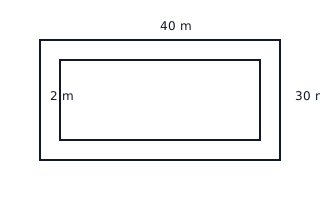
A rectangular plot has a length of and its area is . If a path of width is built inside the plot along its boundary, find the area of the path.
Solution:
- First, find the breadth () of the plot:
- The path is inside, so the inner rectangle dimensions are: Inner length () = Inner breadth () =
- Area of inner rectangle:
- Area of the path:
Explanation:
To find the path's area, we subtract the area of the empty inner space from the total area. The inner dimensions are reduced by twice the path width because the path exists on both sides of the length and breadth.
Problem 6:
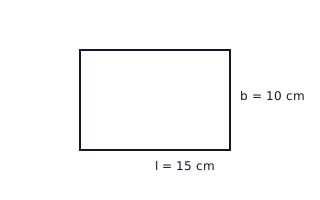
Calculate the area of a rectangle where the sum of the length and breadth is and the difference between them is .
Solution:
- Let length be and breadth be . We are given:
- Adding the two equations:
- Substitute in the first equation:
- Calculate the Area:
Explanation:
We use simultaneous equations to solve for the individual dimensions first. Once the length and breadth are found, we multiply them to find the total area.