krit.club logo

Lines and Angles - Prove and apply standard theorems related to intersecting lines

Grade 9CBSE

Review the key concepts, formulae, and examples before starting your quiz.

🔑Concepts

•

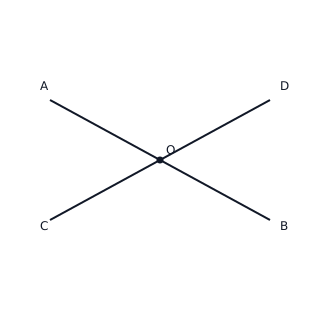
When two lines intersect, the vertically opposite angles are equal. In the diagram, ∠AOC=∠BOD\angle AOC = \angle BOD and ∠AOD=∠BOC\angle AOD = \angle BOC.

Two intersecting lines AB and CD meeting at point O showing vertically opposite angles.
•

A linear pair of angles is formed when two angles are adjacent and their non-common sides form a straight line. The sum of angles in a linear pair is always 180∘180^{\circ}.

•

If a ray stands on a line, then the sum of two adjacent angles so formed is 180∘180^{\circ}. Conversely, if the sum of two adjacent angles is 180∘180^{\circ}, then the non-common arms of the angles form a line.

•

A point where three or more lines intersect is called a point of concurrence, and the lines are called concurrent lines.

📐Formulae

∠A+∠B+∠C=180∘\angle A + \angle B + \angle C = 180^{\circ}

Exterior Angle=Sum of Interior Opposite Angles\text{Exterior Angle} = \text{Sum of Interior Opposite Angles}

∠Ext+∠Intadj=180∘\angle \text{Ext} + \angle \text{Int}_{\text{adj}} = 180^{\circ}

In △ABC, if side BC is extended to D, then ∠ACD=∠CAB+∠ABC\text{In } \triangle ABC, \text{ if side } BC \text{ is extended to } D, \text{ then } \angle ACD = \angle CAB + \angle ABC

Each angle of an equilateral triangle=180∘3=60∘\text{Each angle of an equilateral triangle} = \frac{180^{\circ}}{3} = 60^{\circ}

💡Examples

Problem 1:

The angles of a triangle are in the ratio 2:3:42:3:4. Find the measure of each angle of the triangle.

Solution:

Step 1: Let the angles of the triangle be 2x2x, 3x3x, and 4x4x. Step 2: According to the Angle Sum Property, the sum of these angles must be 180∘180^{\circ}. So, 2x+3x+4x=180∘2x + 3x + 4x = 180^{\circ}. Step 3: Combine the terms: 9x=180∘9x = 180^{\circ}. Step 4: Solve for xx: x=180∘9=20∘x = \frac{180^{\circ}}{9} = 20^{\circ}. Step 5: Calculate each angle: Angle 1: 2x=2×20∘=40∘2x = 2 \times 20^{\circ} = 40^{\circ} Angle 2: 3x=3×20∘=60∘3x = 3 \times 20^{\circ} = 60^{\circ} Angle 3: 4x=4×20∘=80∘4x = 4 \times 20^{\circ} = 80^{\circ}. Verification: 40∘+60∘+80∘=180∘40^{\circ} + 60^{\circ} + 80^{\circ} = 180^{\circ}.

Explanation:

This problem uses the Angle Sum Property. By representing the ratios as algebraic terms, we can set up a linear equation that sums to 180∘180^{\circ} to find the unknown multiplier.

Problem 2:

In △PQR\triangle PQR, the side QRQR is produced to SS. If the exterior angle ∠PRS=105∘\angle PRS = 105^{\circ} and ∠Q=45∘\angle Q = 45^{\circ}, find the measure of ∠P\angle P.

Solution:

Step 1: Identify the given values: Exterior angle ∠PRS=105∘\angle PRS = 105^{\circ} and one interior opposite angle ∠Q=45∘\angle Q = 45^{\circ}. Step 2: Apply the Exterior Angle Theorem: Exterior Angle=Sum of Interior Opposite Angles\text{Exterior Angle} = \text{Sum of Interior Opposite Angles}. Step 3: Write the equation: ∠PRS=∠P+∠Q\angle PRS = \angle P + \angle Q. Step 4: Substitute the values: 105∘=∠P+45∘105^{\circ} = \angle P + 45^{\circ}. Step 5: Solve for ∠P\angle P: ∠P=105∘−45∘=60∘\angle P = 105^{\circ} - 45^{\circ} = 60^{\circ}.

Explanation:

The Exterior Angle Theorem is the most efficient way to solve this. It relates the outside angle directly to the two non-adjacent inside angles, bypassing the need to find the adjacent interior angle ∠PRQ\angle PRQ first.

Problem 3:

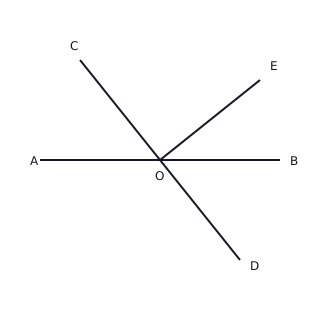
In the given figure, lines ABAB and CDCD intersect at OO. If ∠AOC+∠BOE=70∘\angle AOC + \angle BOE = 70^{\circ} and ∠BOD=40∘\angle BOD = 40^{\circ}, find ∠BOE\angle BOE and reflex ∠COE\angle COE.

Lines AB and CD intersecting at O with a ray OE.

Solution:

  1. Since ABAB and CDCD intersect at OO, ∠AOC=∠BOD\angle AOC = \angle BOD (Vertically opposite angles).
  2. Given ∠BOD=40∘\angle BOD = 40^{\circ}, therefore ∠AOC=40∘\angle AOC = 40^{\circ}.
  3. We are given ∠AOC+∠BOE=70∘\angle AOC + \angle BOE = 70^{\circ}.
  4. Substituting the value of ∠AOC\angle AOC: 40∘+∠BOE=70∘  ⟹  ∠BOE=30∘40^{\circ} + \angle BOE = 70^{\circ} \implies \angle BOE = 30^{\circ}.
  5. ABAB is a straight line, so ∠AOC+∠COE+∠BOE=180∘\angle AOC + \angle COE + \angle BOE = 180^{\circ}.
  6. 40∘+∠COE+30∘=180∘  ⟹  ∠COE=180∘−70∘=110∘40^{\circ} + \angle COE + 30^{\circ} = 180^{\circ} \implies \angle COE = 180^{\circ} - 70^{\circ} = 110^{\circ}.
  7. Reflex ∠COE=360∘−∠COE=360∘−110∘=250∘\angle COE = 360^{\circ} - \angle COE = 360^{\circ} - 110^{\circ} = 250^{\circ}.

Explanation:

We use the property of vertically opposite angles to find ∠AOC\angle AOC, then use the given sum to find ∠BOE\angle BOE, and finally use the linear pair property on line ABAB to find ∠COE\angle COE and its reflex.

Problem 4:

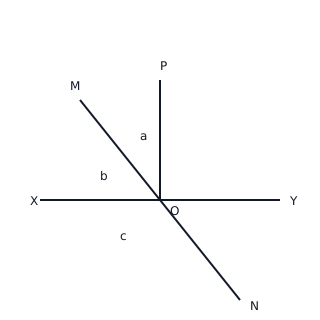
In the figure, lines XYXY and MNMN intersect at OO. If ∠POY=90∘\angle POY = 90^{\circ} and a:b=2:3a:b = 2:3, find cc.

Lines XY and MN intersecting at O with a perpendicular ray OP. Angles a, b, and c are marked.

Solution:

  1. Since XYXY is a straight line, ∠POX+∠POY=180∘\angle POX + \angle POY = 180^{\circ}.
  2. ∠POX+90∘=180∘  ⟹  ∠POX=90∘\angle POX + 90^{\circ} = 180^{\circ} \implies \angle POX = 90^{\circ}.
  3. ∠POX\angle POX is composed of angles aa and bb, so a+b=90∘a + b = 90^{\circ}.
  4. Given ratio a:b=2:3a:b = 2:3, let a=2xa = 2x and b=3xb = 3x.
  5. 2x+3x=90∘  ⟹  5x=90∘  ⟹  x=18∘2x + 3x = 90^{\circ} \implies 5x = 90^{\circ} \implies x = 18^{\circ}.
  6. b=3×18∘=54∘b = 3 \times 18^{\circ} = 54^{\circ}.
  7. MNMN is a straight line, so b+c=180∘b + c = 180^{\circ} (Linear pair).
  8. 54∘+c=180∘  ⟹  c=180∘−54∘=126∘54^{\circ} + c = 180^{\circ} \implies c = 180^{\circ} - 54^{\circ} = 126^{\circ}.

Explanation:

Identify that the sum of angles on the left side of the perpendicular is 90∘90^{\circ}. Use the ratio to find angle bb, then use the fact that MNMN is a straight line to find cc via a linear pair.