
Review the key concepts, formulae, and examples before starting your quiz.
🔑Concepts
A Ray is a part of a line that starts at a fixed point (endpoint) and extends infinitely in one direction. An Angle is formed when two rays originate from the same endpoint (vertex).
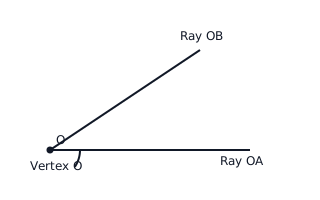
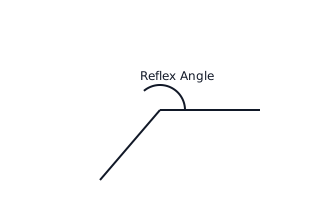
Angles are classified by their measure: Acute (), Right (), Obtuse (), Straight (), and Reflex ().
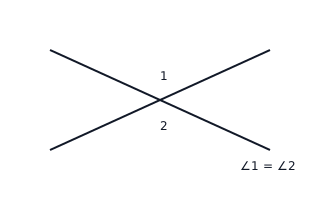
When two lines intersect, the Vertically Opposite Angles are equal. These angles are formed opposite to each other at the vertex.
Two angles are Adjacent if they have a common vertex, a common arm, and their non-common arms are on different sides of the common arm.
📐Formulae
Sum of Complementary Angles:
Sum of Supplementary Angles:
Linear Pair Axiom:
Reflex Angle calculation:
💡Examples
Problem 1:
Find the measure of an angle which is more than its complement.
Solution:
- Let the measure of the required angle be .
- Its complement will be .
- According to the problem:
- Simplify the equation:
Explanation:
We use the definition of complementary angles (sum is ) to set up a linear equation based on the given condition.
Problem 2:
In a linear pair, the ratio of two adjacent angles is . Find the measure of both angles.
Solution:
- Let the two angles be and .
- Since they form a linear pair, their sum is .
- First angle:
- Second angle:
Explanation:
Using the Linear Pair Axiom, we sum the ratio-based components to to find the common multiplier , then calculate individual angles.
Problem 3:
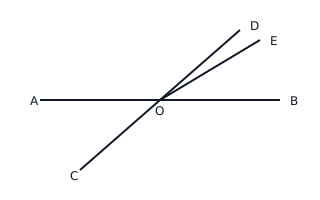
In the given figure, lines and intersect at . If and , find and reflex .
Solution:
- (Vertically opposite angles).
- Since , then .
- Given , so .
- is a straight line, so .
- .
- Reflex .
Explanation:
We use the properties of vertically opposite angles to find , then use the given sum to find . Finally, we use the straight line property to find and subtract it from for the reflex angle.
Problem 4:
In the figure, . Prove that .
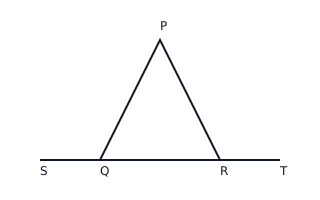
Solution:
- is a straight line, so (Linear pair).
- Similarly, is a straight line, so (Linear pair).
- Therefore, .
- Since it is given that , we can subtract this equal value from both sides.
- Hence, .
Explanation:
This proof relies on the Linear Pair Axiom which states that angles on a straight line add up to . If inner angles are equal, their supplementary outer angles must also be equal.