
Review the key concepts, formulae, and examples before starting your quiz.
🔑Concepts
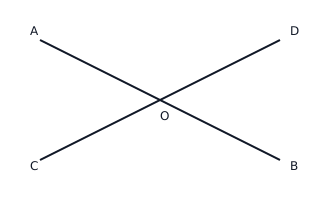
When two lines intersect, the angles opposite each other at the vertex are called Vertically Opposite Angles and they are always equal. For lines and intersecting at , and .
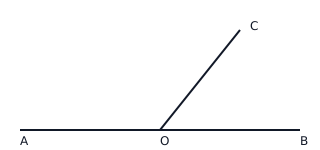
A Linear Pair of angles is formed when two adjacent angles are formed by a ray standing on a straight line. The sum of these angles is always . If ray stands on line , then .
The sum of all angles formed around a single point is , representing a complete rotation.
If the sum of two adjacent angles is , then the non-common arms of the angles form a straight line. This is the converse of the Linear Pair Axiom.
📐Formulae
Linear Pair:
Vertically Opposite Angles: and (for lines and intersecting at )
Sum of angles around a point:
Perpendicular Condition:
Parallel Condition:
💡Examples
Problem 1:
Two lines and intersect at point . If , find the measures of , , and .
Solution:
- Since is a straight line and ray stands on it, and form a linear pair. Therefore, .
- Substitute the given value: .
- and are vertically opposite angles, so .
- and are vertically opposite angles, so .
Explanation:
This problem uses the Linear Pair Axiom to find the adjacent supplement and the property of Vertically Opposite Angles to find the angles across the intersection.
Problem 2:
In a figure, lines and intersect at . If and (where and ), find the value of .
Solution:
- Since is a line, . Given , then .
- We know , so .
- Given , let and . Then .
- Calculate : .
- Since is a straight line, and form a linear pair. Thus, .
- Substitute : .
Explanation:
The solution first uses the linear pair property on line to isolate the sum of and , then uses ratios to find their specific values, and finally applies the linear pair property on line to find .
Problem 3:
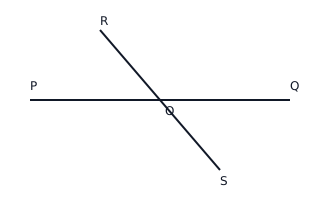
In the given figure, lines and intersect each other at point . If , find all the angles.
Solution:
Explanation:
We use the ratio to express the adjacent angles in terms of . Since they form a linear pair on the straight line , their sum is . Solving for gives the specific measures. Finally, we apply the property of vertically opposite angles to find the remaining two angles.
Problem 4:
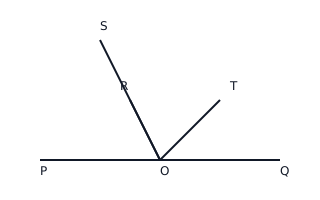
In the figure, ray stands on a line . Ray and ray are angle bisectors of and , respectively. If , find .
Solution:
Explanation:
By using the Linear Pair property, we determine the expression for . Since and are bisectors, they halve their respective angles. Adding these two half-angles shows that the angle between the bisectors of a linear pair is always a right angle.