
Lines and Angles - Apply parallel-line theorems with transversals to deduce unknown angles
Review the key concepts, formulae, and examples before starting your quiz.
🔑Concepts
When two parallel lines are intersected by a transversal, the corresponding angles formed are equal in measure. For example, if line , then , , etc.
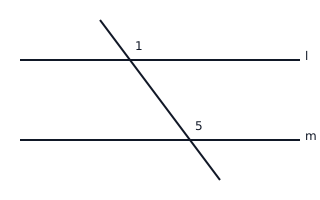
Alternate Interior Angles are equal when lines are parallel. These angles lie between the two lines and on opposite sides of the transversal (forming a 'Z' shape).
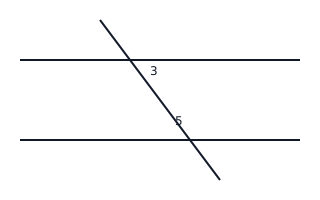
Co-interior angles (Consecutive Interior Angles) lie on the same side of the transversal and between the parallel lines. They are supplementary, meaning their sum is .
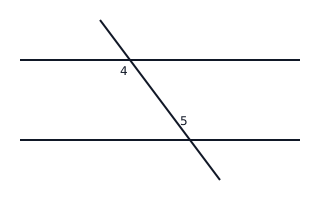
Transitive Property of Parallelism: Lines which are parallel to the same line are parallel to each other. If and , then .
📐Formulae
If , then
If , then
Sum of Co-interior Angles: (when lines are parallel)
Sum of Angles on a Straight Line:
Vertically Opposite Angles: and at any intersection
💡Examples
Problem 1:
In the figure, line and a transversal intersects them. If one of the interior angles on the same side of the transversal is and the other is , find the value of .
Solution:
- Since , the sum of interior angles on the same side of the transversal (co-interior angles) is .
- Write the equation: .
- Combine like terms: .
- Subtract from both sides: .
- Divide by : .
Explanation:
The solution uses the Co-interior Angle Theorem which states that consecutive interior angles are supplementary when lines are parallel.
Problem 2:
Two parallel lines are intersected by a transversal. If a pair of alternate interior angles are given by and , find the value of .
Solution:
- Identify the relationship: Alternate interior angles are equal when lines are parallel.
- Set up the equation: .
- Add to both sides: .
- Divide by : .
Explanation:
This problem relies on the property that alternate interior angles (the 'Z-shape' angles) have the same measure when lines are parallel.
Problem 3:
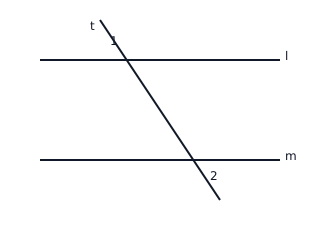
In the given figure, line and is the transversal. If and represent a pair of alternate exterior angles, find the value of and the measure of .
Solution:
Explanation:
When two parallel lines are intersected by a transversal, the pair of alternate exterior angles are equal in measure. By equating the given linear expressions, we solve for the variable and then calculate the specific angle value.
Problem 4:
In the figure, and . Also, . If , find the values of and .
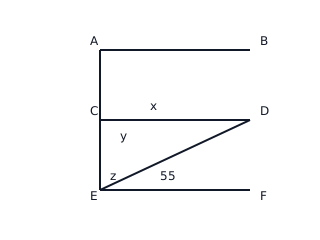
Solution:
Explanation:
We use the properties of parallel lines: co-interior angles are supplementary () and corresponding angles are equal. Since is parallel to and is parallel to , is also parallel to (transitive property).