
Introduction to Euclid's Geometry: Axioms and Postulates - Use measurement axioms to justify geometric constructions step by step
Review the key concepts, formulae, and examples before starting your quiz.
🔑Concepts
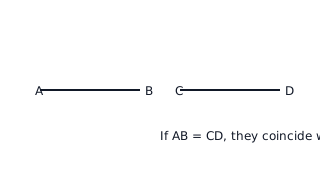
Euclid's Axioms and Postulates provide the logical foundation for geometric constructions. Measurements of length and angle are justified by the 'Common Notions,' such as things which coincide with one another being equal to one another.
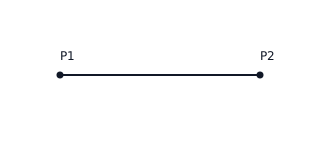
Postulate 1 states that a straight line may be drawn from any one point to any other point. This justifies the use of a straightedge to connect two marked points in a construction.
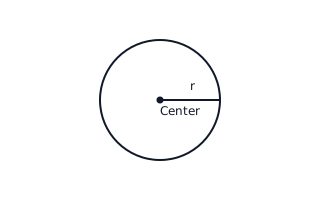
Postulate 3 allows the description of a circle with any center and distance (radius). This is the basis for using a compass to measure and transfer lengths in constructions.
Measurement axioms imply that the whole is greater than the part. In constructions involving midpoints, we use the logic that if is between and , then .
📐Formulae
Sum of interior angles for intersection:
Sum of interior angles for parallel lines:
Angle sum of a triangle:
Playfair's Axiom condition: such that and
💡Examples
Problem 1:
Consider a line and a point not on . If line and line both pass through point , and it is given that , can also be parallel to ?
Solution:
- According to Playfair's Axiom, for a given line and a point outside it, there exists a unique line passing through that is parallel to .
- The problem states that passes through and .
- Since the parallel line through is unique, no other line passing through (like ) can be parallel to .
- Therefore, cannot be parallel to ; it must eventually intersect .
Explanation:
This solution uses Playfair's Axiom, which is an equivalent version of Euclid's fifth postulate, to prove the uniqueness of parallel lines through a specific point.
Problem 2:
In a figure, two lines and are cut by a transversal . The interior angles on the same side of are measured as and . According to Euclid's fifth postulate, will the lines and intersect? If so, on which side?
Solution:
- Identify the interior angles on the same side of the transversal: and .
- Calculate the sum of these interior angles: .
- Compare the sum to (two right angles): .
- Euclid's fifth postulate states that if the sum is less than , the lines will meet on that side.
- Conclusion: The lines and will intersect on the side where the angles were measured.
Explanation:
This example demonstrates the direct application of the original text of Euclid's Fifth Postulate regarding the sum of interior angles.
Problem 3:
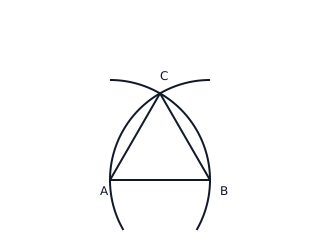
Prove that an equilateral triangle can be constructed on any given line segment using Euclid's Postulates.
Solution:
- Let be the given line segment.
- Draw a circle with center and radius (Postulate 3).
- Draw another circle with center and radius (Postulate 3).
- Let the two circles intersect at point .
- Draw line segments and (Postulate 1).
- Since and are radii of the same circle, .
- Since and are radii of the same circle, .
- By Axiom 1 (things equal to the same thing are equal), .
- Thus, is equilateral.
Explanation:
This construction relies on Postulate 3 for circles and Axiom 1 to equate the lengths of the sides based on their shared relationship to segment .
Problem 4:
Given a line segment of length , and a point lying between and , such that , prove that using Euclid's axioms.
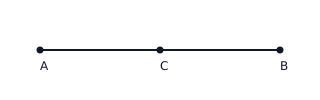
Solution:
- It is given that .
- Add to both sides: (Axiom 2: if equals are added to equals, the wholes are equal).
- .
- Since lies between and , the segment coincides with (Axiom 4: things that coincide are equal).
- Therefore, .
- Dividing by 2, we get .
Explanation:
This uses the 'addition of equals' axiom and the 'coincidence' axiom to relate the part to the whole measurement.