
Introduction to Euclid's Geometry: Axioms and Postulates - Construct a square using Sulbasutra method and explain construction logic
Review the key concepts, formulae, and examples before starting your quiz.
🔑Concepts
The Sulbasutras (c. 800–500 BCE) are ancient Indian mathematical texts that provided rules for constructing complex geometric shapes for sacrificial altars (Vedi). The most fundamental construction is the square, derived using a 'rajju' (cord or rope) and a 'shanku' (gnomon or peg).
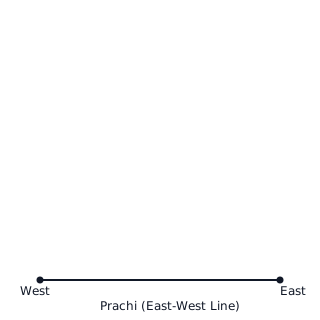
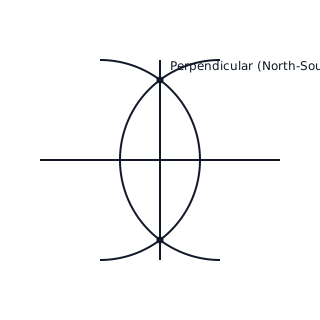
The construction begins by establishing the 'Prachi' (East-West line). A cord of length equal to the desired side is fixed at the center. To ensure perpendicularity, the Baudhayana Sulbasutra utilizes the property of intersecting arcs. Arcs of equal radii are drawn from two points on the reference line to find the North and South cardinal points.
The logic behind the Sulbasutra construction is rooted in what is now known as the Pythagoras Theorem, referred to in these texts as the Baudhayana Theorem. It states that the area produced by the diagonal of a rectangle is equal to the sum of the areas produced by the two sides. This is used to verify the 'squareness' of the construction by checking the diagonal cord length.
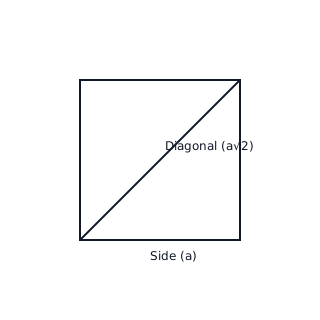
For accurate construction, the Sulbasutras provide a numerical approximation for the diagonal of a unit square (). This is given by the formula: . This precise calculation allowed the priests to ensure the square altars were geometrically perfect for ritualistic efficacy.
The final step involves marking the four corners. By using a cord of length and verifying that the distance between opposite corners (the diagonal) matches the calculated value , a perfect square is formed. The logic relies on the fact that if a quadrilateral has four equal sides and equal diagonals, it must be a square.
📐Formulae
💡Examples
Problem 1:
Describe the construction of a square with side using the Sulbasutra method and explain the logic of perpendicularity.
Solution:
- Let be the given side of the square. Fix pegs at and .
- To find the perpendicular at , extend the line to a point such that .
- Take a rope longer than . Fix one end at and the other at . Stretch the rope and mark its midpoint .
- Swing an arc (or circle) from and . The intersection point (where is perpendicular to ) is found by ensuring .
- Repeat the process or use the rope to mark point such that and .
- is the required square.
Explanation:
The logic relies on the property of the isosceles triangle and the perpendicular bisector. By creating a point such that , becomes the midpoint of segment . Any point equidistant from and (forming an isosceles triangle ) will result in being the altitude and perpendicular bisector of . Since and , we establish the right-angled corner of the square.
Problem 2:
Use the Baudhayana theorem logic to find the length of the diagonal of a square altar if the side is units.
Solution:
Given side . According to the Baudhayana (Pythagorean) theorem: Using the Sulbasutra approximation for :
Explanation:
The Sulbasutras utilized the relationship between the sides and the diagonal to ensure the 'Katurasra' (square) was perfectly oriented and shaped for ritual purposes.
Problem 3:
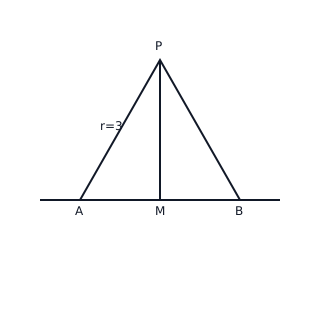
In the construction of a square altar using the Sulbasutra method, if the reference cord used to draw the arcs from two points on the line (distance units apart) has a length of units, determine the distance from the midpoint to the intersection point of the arcs.
Solution:
- Let the distance between the two points and on the line be units.
- The midpoint is at a distance of units from and .
- The arcs are drawn with radius units.
- Let be the intersection point of the arcs. is a right-angled triangle where (hypotenuse) and (base).
- By Baudhayana Theorem:
- units.
Explanation:
The vertical height from the base line to the intersection point ensures the perpendicularity required for a square corner, following the logic that the diagonal distance and base create a right angle at the midpoint.
Problem 4:
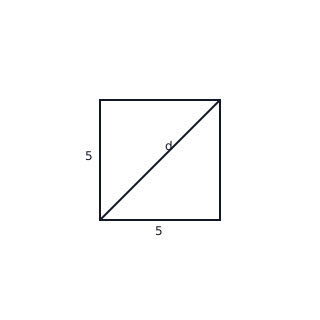
Construct a square whose side is units. If the diagonal cord is used to verify the squareness, what should its length be according to the Sulbasutra approximation for ?
Solution:
- Given side units.
- The diagonal .
- Using the Sulbasutra formula for : .
- units.
Explanation:
The diagonal of a square must satisfy the relationship . The Sulbasutras provided a highly accurate rational approximation for to ensure precision in altar construction.