
Introduction to Euclid's Geometry: Axioms and Postulates - Trace historical development of geometry and major civilisational contributions
Review the key concepts, formulae, and examples before starting your quiz.
🔑Concepts
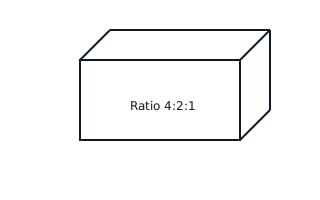
The term 'Geometry' is derived from the Greek words 'geo' (earth) and 'metrein' (to measure). Ancient civilizations used geometry for practical needs like land measurement, architecture, and irrigation. In Egypt, geometry was essential for restoring boundaries after the Nile's annual flooding, while in the Indus Valley Civilization (Harappa and Mohenjo-Daro), bricks were produced in a fixed ratio of for length, breadth, and thickness.
Euclid, a teacher of mathematics at Alexandria, organized the known geometrical knowledge of his time into a treatise called 'The Elements'. He divided it into thirteen chapters, each called a 'book'. He began his work by defining basic terms such as point, line, and surface, which he used to build his system of axioms and postulates.

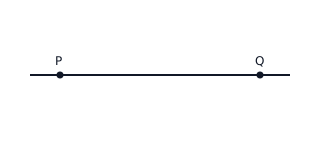
Euclid's Postulate 1 states that a straight line may be drawn from any one point to any other point. This is supplemented by the axiom that through two distinct points, there is a unique line passing through them.
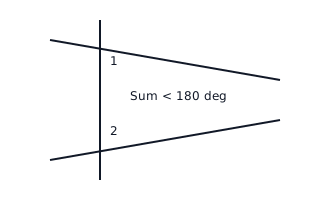
Euclid's Postulate 5 (Parallel Postulate) states that if a straight line falling on two straight lines makes the interior angles on the same side less than two right angles (), the two straight lines, if produced indefinitely, meet on that side where the sum of angles is less than two right angles.
📐Formulae
💡Examples
Problem 1:
If a point lies between two points and such that , then prove that .
Solution:
Given . Adding to both sides (Euclid's Axiom 2: If equals are added to equals, the wholes are equal): Since coincides with (Euclid's Axiom 4: Things which coincide with one another are equal to one another): Dividing both sides by (Euclid's Axiom 7: Things which are halves of the same things are equal to one another):
Explanation:
This proof utilizes Euclid's Axioms regarding addition and halves to show the relationship between the segments of a bisected line.
Problem 2:
Given two distinct points and , is there at least one line that passes through them?
Solution:
Yes, according to Euclid's Postulate 1: 'A straight line may be drawn from any one point to any other point.' Modern geometry refines this as an axiom stating: 'Given two distinct points, there is a unique line that passes through them.'
Explanation:
This is a direct application of Euclid's first postulate, asserting the existence of a path between two points.
Problem 3:
Consider the following statement: There exists a pair of straight lines that are everywhere equidistant from one another. Is this statement a direct consequence of Euclid’s fifth postulate? Explain.
Solution:
Yes. This statement is equivalent to the existence of parallel lines. If the distance between two lines is constant, they will never meet, which corresponds to the case where the sum of interior angles on the same side is exactly ( right angles).
Explanation:
This is a reinterpretation of the Parallel Postulate (Postulate 5) through the lens of equidistance.
Problem 4:
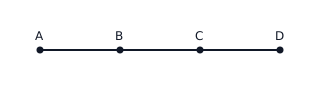
In the figure, if , then prove that .
Solution:
- We are given .
- From the figure, can be written as and can be written as .
- Substituting these in the given equation: .
- According to Euclid's axiom, 'If equals are subtracted from equals, the remainders are equal'. Subtracting from both sides:
Explanation:
This problem uses Euclid's axiom about subtraction of equals to show the relationship between overlapping line segments on a straight line.
Problem 5:
Show that an equilateral triangle can be constructed on any given line segment.
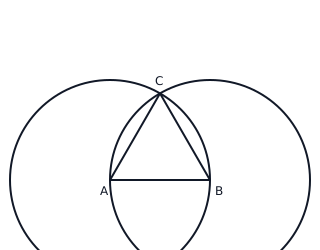
Solution:
- Let be the given line segment.
- Using Euclid's Postulate 3, draw a circle with center and radius .
- Draw another circle with center and radius .
- Let the two circles intersect at point .
- Draw line segments and (Postulate 1).
- Now, (radii of the same circle) and (radii of the same circle).
- By Euclid's Axiom 1 (Things which are equal to the same thing are equal to one another), .
- Therefore, is an equilateral triangle.
Explanation:
This construction demonstrates the application of Euclid's postulates regarding circles and lines, combined with his first axiom regarding equality.