
Introduction to Euclid's Geometry: Axioms and Postulates - Apply Euclidean definitions, axioms, and postulates in geometric arguments
Review the key concepts, formulae, and examples before starting your quiz.
🔑Concepts
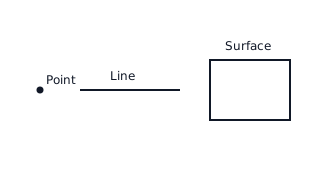
Euclidean definitions categorize geometric entities. A point has no parts; a line has length but no breadth; the ends of a line are points; a surface has length and breadth only.
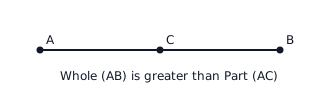
Axioms are general mathematical truths assumed without proof, such as 'The whole is greater than the part.' If a part is removed from , then .
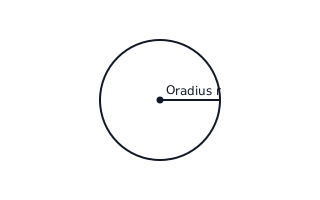
Postulates are assumptions specific to geometry. For instance, Postulate 3 states that a circle can be drawn with any center and any radius.
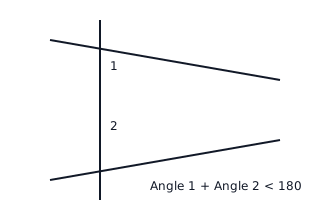
Euclid's Fifth Postulate (Parallel Postulate) states that if a straight line falling on two straight lines makes the interior angles on the same side less than two right angles (), the two lines, if produced indefinitely, meet on that side.
📐Formulae
If and , then (Adding equals to equals)
If and , then (Subtracting equals from equals)
If and , then (Transitive property of equality)
If , then (Doubles of equals are equal)
If , then (Halves of equals are equal)
Sum of interior angles Lines intersect
💡Examples
Problem 1:
If a point lies between two points and such that , then prove that . Explain by drawing the figure.
Solution:
- We are given .
- According to Euclid's axiom, 'if equals are added to equals, the wholes are equal'.
- Let us add to both sides of the given equation: .
- This gives .
- From the visual representation of the line segment, the point lies between and , so coincides with the line segment .
- According to the axiom 'things which coincide with one another are equal to one another', we have .
- Therefore, .
- Dividing both sides by (or taking halves), we get .
Explanation:
This solution utilizes Euclid's Axiom 2 (adding equals to equals) and Axiom 4 (coinciding objects) to establish a relationship between a part of a segment and the whole segment.
Problem 2:
Prove that an equilateral triangle can be constructed on any given line segment.
Solution:
- Let be the given line segment.
- Using Euclid's Postulate 3 (a circle can be drawn with any centre and radius), draw a circle with centre and radius .
- Similarly, draw another circle with centre and radius .
- Let these two circles intersect at a point .
- Draw line segments and (Postulate 1).
- Now, (radii of the same circle).
- Also, (radii of the same circle).
- According to Euclid's Axiom 1 (things equal to the same thing are equal to each other), since and , then .
- Thus, . Since all three sides are equal, is an equilateral triangle.
Explanation:
This proof demonstrates the application of Euclid's Postulates 1 and 3 along with Axiom 1 to construct a geometric figure based on fundamental assumptions.
Problem 3:
In the given figure, if , then prove that .
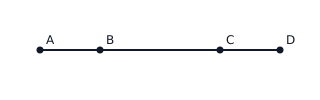
Solution:
- Given: .
- From the figure, we see that and .
- Substituting these into the given equation: .
- According to Euclid's Axiom 3 (If equals are subtracted from equals, the remainders are equal), we subtract from both sides.
- .
- Therefore, .
Explanation:
This argument applies the axiom that subtracting the same quantity () from equal total lengths ( and ) maintains equality.
Problem 4:
Two distinct lines cannot have more than one point in common. Prove this using geometric logic.
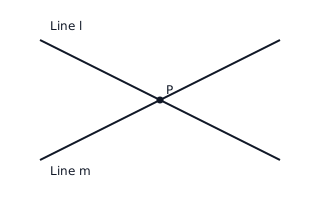
Solution:
- Let there be two distinct lines and .
- Suppose they have two distinct common points, and .
- According to Euclid's Postulate 1, there is a unique line that passes through two distinct points.
- This means both lines and must be the same line because they both pass through and .
- This contradicts our assumption that lines and are distinct.
- Hence, two distinct lines can have only one point in common.
Explanation:
This proof uses the method of contradiction based on the postulate that two points uniquely determine a line.