
Review the key concepts, formulae, and examples before starting your quiz.
🔑Concepts
A quadrilateral is called cyclic if all four vertices lie on a single circle. These vertices are called concyclic points.
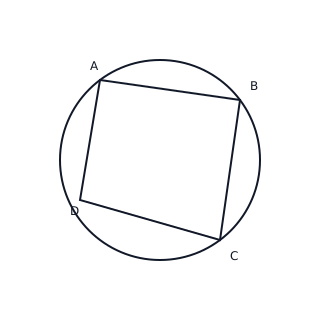
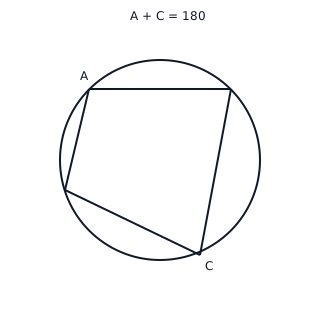
The sum of either pair of opposite angles of a cyclic quadrilateral is . Conversely, if the sum of a pair of opposite angles of a quadrilateral is , the quadrilateral is cyclic.
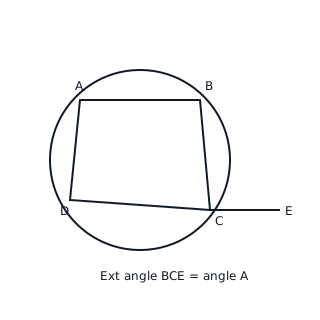
The exterior angle of a cyclic quadrilateral is equal to the interior opposite angle.
If a line segment joining two points subtends equal angles at two other points lying on the same side of the line containing the segment, the four points are concyclic.
📐Formulae
💡Examples
Problem 1:
In a cyclic quadrilateral , if and , find the value of and the measure of and .
Solution:
Step 1: We know that in a cyclic quadrilateral, the sum of opposite angles is . Therefore, . Step 2: Substitute the given expressions: . Step 3: Combine like terms: . Step 4: Solve for : . Step 5: Calculate the angles: and .
Explanation:
This problem applies the property that opposite angles of a cyclic quadrilateral are supplementary. By setting up a linear equation based on the sum being , we can solve for the unknown variable.
Problem 2:
In the given figure of a cyclic quadrilateral , side is produced to . If the exterior angle and , find given that .
Solution:
Step 1: Use the exterior angle property. The exterior angle is equal to the interior opposite angle . Thus, . Step 2: In , we are given . This means is an isosceles triangle. Step 3: In an isosceles triangle, angles opposite to equal sides are equal. Therefore, . Step 4: Since , it follows that .
Explanation:
This problem demonstrates the Exterior Angle Property of cyclic quadrilaterals and combines it with properties of isosceles triangles. The exterior angle helps identify one interior angle, which then allows us to use triangle properties to find others.
Problem 3:
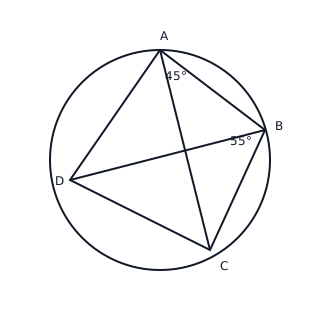
In the figure, is a cyclic quadrilateral in which and are its diagonals. If and , find .
Solution:
- In the same segment, angles subtended by the same chord are equal. Therefore, .
- Now, .
- Since is a cyclic quadrilateral, the sum of opposite angles is .
- .
- .
Explanation:
We use the property that angles in the same segment of a circle are equal to find the full angle at A, then use the cyclic quadrilateral property of supplementary opposite angles.
Problem 4:
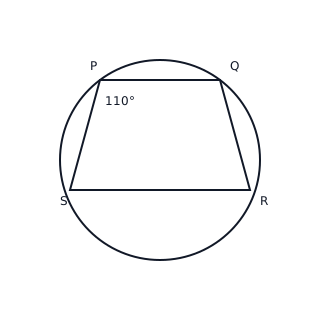
In a cyclic quadrilateral , the side is parallel to . If , find the measure of , and .
Solution:
- In cyclic quadrilateral , opposite angles sum to . Therefore, .
- .
- Since , the consecutive interior angles sum to . Therefore, .
- .
- Similarly, for the cyclic property, .
- .
Explanation:
Because the quadrilateral is cyclic, opposite angles are supplementary. Because , adjacent angles between the parallels are also supplementary. This reveals that the quadrilateral is an isosceles trapezium.