
Review the key concepts, formulae, and examples before starting your quiz.
🔑Concepts
Equal chords of a circle (or of congruent circles) are equidistant from the centre. This means if , then the perpendicular distances and from the centre to these chords are equal ().
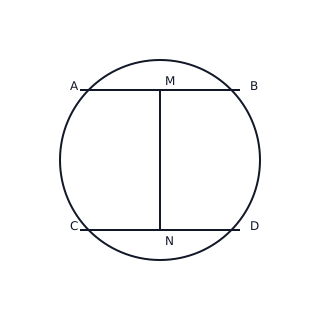
Chords equidistant from the centre of a circle are equal in length. If the perpendicular distances from the centre to two chords are the same, the chords must have the same length ().
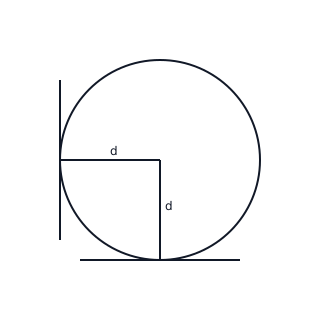
Of any two chords of a circle, the longer chord is nearer to the centre. Conversely, the chord which is nearer to the centre is longer.
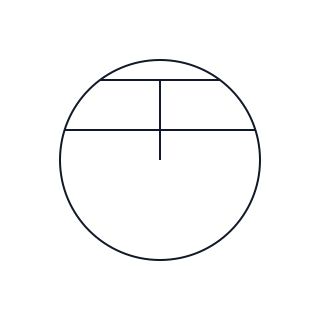
The perpendicular from the centre of a circle to a chord bisects the chord. This forms a right-angled triangle where the hypotenuse is the radius, allowing for the use of the Pythagoras Theorem: .
📐Formulae
Pythagorean relationship:
Perpendicular distance from center:
Length of the chord:
Radius of the circle:
If and are chords and , , then:
💡Examples
Problem 1:
In a circle of radius cm, two equal chords and are drawn. If the length of chord is cm, calculate the distance of chord from the center of the circle.
Solution:
Step 1: Identify that since and are equal chords ( cm), they are equidistant from the center. Thus, finding the distance of will give the distance of . Step 2: Let be the center and . By the perpendicular bisector theorem, bisects . So, cm. Step 3: In right-angled triangle , we have radius cm and base cm. Using Pythagoras Theorem: Step 4: Substitute the values: Step 5: Solve for : . Since equal chords are equidistant, the distance of from the center is also cm.
Explanation:
This problem uses the property that the perpendicular from the center bisects the chord and applies the Pythagorean theorem to find the distance. The final step relies on the theorem that equal chords are equidistant from the center.
Problem 2:
Two parallel chords and of lengths cm and cm respectively are on opposite sides of the center of a circle. If the radius of the circle is cm, find the distance between the two chords.
Solution:
Step 1: Let the center be . Draw and . Since and they are on opposite sides, the distance between them is . Step 2: Calculate for chord cm. cm. In : Step 3: Calculate for chord cm. cm. In : Step 4: The total distance between the chords is cm.
Explanation:
The problem requires calculating the individual distances of two different chords from the center using the Pythagorean theorem and then summing those distances because the chords lie on opposite sides of the center.
Problem 3:
In a circle of radius cm, two chords and are drawn such that they are at distances of cm and cm from the centre respectively. Find the difference in the lengths of the two chords.
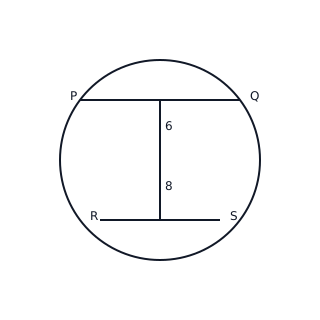
Solution:
-
For chord : radius cm and distance cm. Using Pythagoras Theorem: cm. So, cm.
-
For chord : radius cm and distance cm. cm. So, cm.
-
Difference in lengths = cm.
Explanation:
By calculating the length of each chord using the distance from the centre and the radius, we observe that the chord closer to the centre ( cm) is longer than the chord further away ( cm).
Problem 4:
Two equal chords and of a circle with centre intersect at a point within the circle. Prove that the line segment bisects the angle .
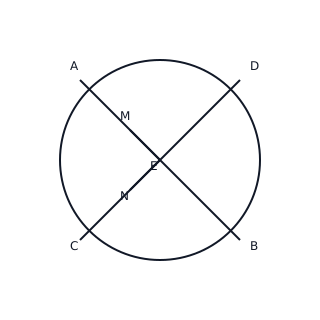
Solution:
- Draw perpendiculars and .
- Since (given), we know (equal chords are equidistant from the centre).
- In and :
- (By construction)
- (Common hypotenuse)
- (Proved above)
- by RHS congruence rule.
- Therefore, (By CPCT).
- Thus, bisects , which is the same as .
Explanation:
This proof uses the property that equal chords are at equal distances from the centre to establish congruent triangles, leading to the equality of angles.