
Review the key concepts, formulae, and examples before starting your quiz.
🔑Concepts
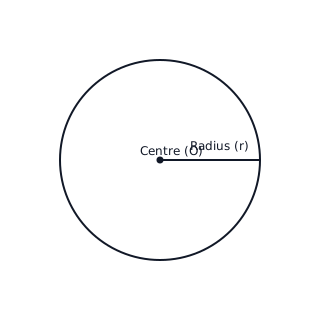
A circle is the collection of all points in a plane which are at a fixed distance (radius) from a fixed point (centre). The distance around the boundary is the circumference.
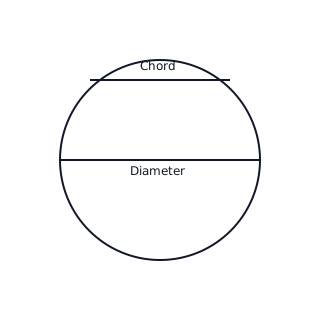
A chord is a line segment joining any two points on the circle. The diameter is the longest chord, passing through the centre, and is equal to radius.
A piece of a circle between two points is called an arc. The region between a chord and either of its arcs is called a segment (Major and Minor).

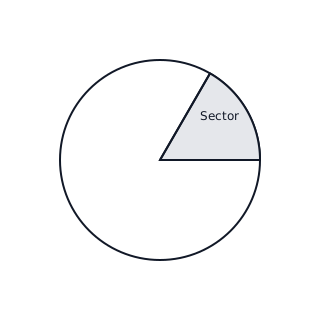
The region between an arc and the two radii joining the centre to the endpoints of the arc is called a sector.
📐Formulae
💡Examples
Problem 1:
If the radius of a circle is cm, find the length of the longest chord of the circle.
Solution:
- We know that the longest chord of a circle is its diameter ().
- The relationship between diameter and radius is given by .
- Given cm.
- Substitute the value: cm.
Explanation:
The problem asks for the longest chord, which is the definition of the diameter. By multiplying the given radius by 2, we find the length.
Problem 2:
A point is at a distance of cm from the center of a circle with a diameter of cm. Determine if point lies in the interior, exterior, or on the circle.
Solution:
- First, find the radius () of the circle: cm.
- The distance of point from the center is given as cm.
- Compare the distance with the radius : Since , we have .
- Therefore, the point lies in the exterior of the circle.
Explanation:
To determine the position of a point, we compare its distance from the center to the radius. If distance , it is in the exterior; if distance , it is in the interior; if distance , it is on the circle.
Problem 3:
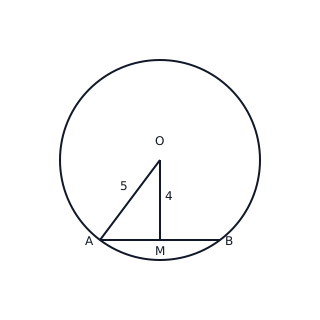
In a circle with centre and radius cm, a chord is drawn. If the distance of the chord from the centre is cm, find the length of the chord .
Solution:
- Let be the perpendicular from the centre to chord . Thus cm.
- is the radius, so cm.
- In right , by Pythagoras Theorem: cm.
- Since the perpendicular from the centre bisects the chord, cm.
Explanation:
The perpendicular from the centre of a circle to a chord bisects the chord. This allows us to use the Pythagorean theorem on the triangle formed by the radius, the distance from the centre, and half the chord.
Problem 4:
Given a circle with centre , identify the major arc and minor arc if points and are on the circumference such that .
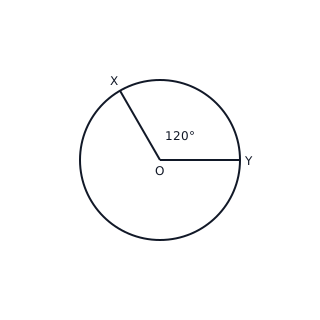
Solution:
- The minor arc is the part of the circumference corresponding to the central angle of .
- The major arc corresponds to the reflex angle .
- Reflex .
Explanation:
An arc is 'minor' if the angle subtended at the centre is less than , and 'major' if it is greater than .