
Review the key concepts, formulae, and examples before starting your quiz.
🔑Concepts
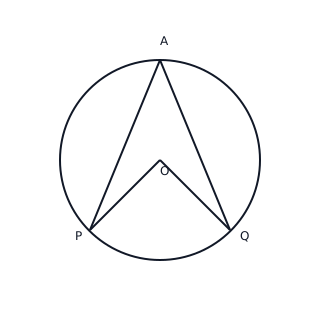
The angle subtended by an arc at the centre is double the angle subtended by it at any point on the remaining part of the circle. This means if an arc subtends at center and at point on the circle, then .
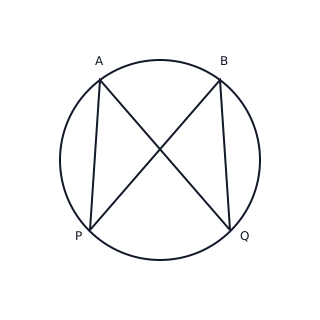
Angles in the same segment of a circle are equal. If points and are on the same arc, then for any points and on the other arc.
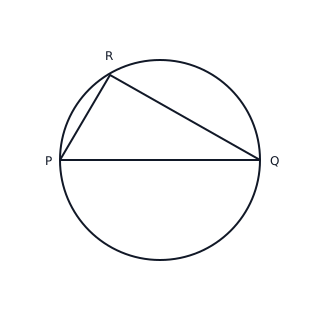
The angle in a semicircle is a right angle (). If is the diameter of a circle, then any point on the circumference will satisfy .
In a cyclic quadrilateral, the sum of opposite angles is . For quadrilateral where all vertices lie on a circle, and .
📐Formulae
(Angles in the same segment)
In cyclic quadrilateral : and
Degree measure of arc :
💡Examples
Problem 1:
In a circle with center , an arc subtends an angle of at the center. Find the measure of the angle where is a point on the major arc.
Solution:
Step 1: Identify the given information. The angle subtended by arc at the center is .\nStep 2: Apply the theorem that the angle at the center is double the angle at the circumference. Therefore, .\nStep 3: Substitute the value: .\nStep 4: Solve for : .
Explanation:
We use the central angle theorem which relates the angle at the center to the angle at any point on the remaining part of the circle.
Problem 2:
Points and are four points on a circle. and intersect at a point such that and . Find .
Solution:
Step 1: In , is an exterior angle. Therefore, .\nStep 2: Substitute the known values: .\nStep 3: Calculate .\nStep 4: Recognize that and (which is the same as ) are angles in the same segment subtended by the arc .\nStep 5: Since angles in the same segment are equal, .
Explanation:
This problem combines the exterior angle property of a triangle with the theorem that angles in the same segment of a circle are equal.
Problem 3:
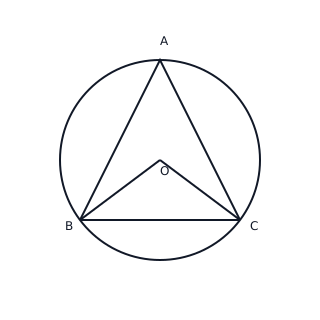
In the given figure, is the center of the circle. If , find the measure of .
Solution:
- In , (Radii of the same circle).
- Therefore, (Angles opposite to equal sides).
- Sum of angles in is :
- By the central angle theorem, .
- .
Explanation:
The problem uses the properties of isosceles triangles formed by radii and the theorem relating the central angle to the inscribed angle.
Problem 4:
In a circle, is a diameter and is a point on the circle. If , calculate .
Solution:
- Since is a diameter, (Angle in a semicircle).
- In , the sum of angles is :
- Substitute the known values:
- .
Explanation:
This solution relies on the property that any angle inscribed in a semicircle is a right angle, followed by the triangle angle sum property.