krit.club logo

4-gons (Quadrilaterals) - Use coordinate geometry to find midpoints and missing vertex of parallelograms

Grade 9CBSE

Review the key concepts, formulae, and examples before starting your quiz.

🔑Concepts

•

In coordinate geometry, the midpoint MM of a line segment joining A(x1,y1)A(x_1, y_1) and B(x2,y2)B(x_2, y_2) is calculated as M=(x1+x22,y1+y22)M = \left( \frac{x_1 + x_2}{2}, \frac{y_1 + y_2}{2} \right). This is fundamental for bisecting segments.
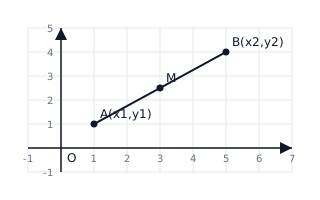
A line segment AB on a coordinate plane with its midpoint M highlighted.
•

A key property of any parallelogram ABCDABCD is that its diagonals ACAC and BDBD bisect each other. This means they share the exact same midpoint.
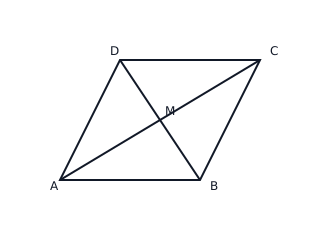
Parallelogram ABCD showing diagonals AC and BD intersecting at their common midpoint M.
•

To find a missing vertex (x4,y4)(x_4, y_4) when three vertices are known, equate the midpoint of diagonal ACAC to the midpoint of diagonal BDBD. This results in the linear equations: x1+x3=x2+x4x_1 + x_3 = x_2 + x_4 and y1+y3=y2+y4y_1 + y_3 = y_2 + y_4.

•

This midpoint method is often more efficient than using the distance formula or slope equations when dealing with parallelograms (including rectangles, rhombuses, and squares) in a coordinate plane.

📐Formulae

M(x,y)=(x1+x22,y1+y22)M(x, y) = \left( \frac{x_1 + x_2}{2}, \frac{y_1 + y_2}{2} \right)

Midpoint of AC=(x1+x32,y1+y32)\text{Midpoint of } AC = \left( \frac{x_1 + x_3}{2}, \frac{y_1 + y_3}{2} \right)

Midpoint of BD=(x2+x42,y2+y42)\text{Midpoint of } BD = \left( \frac{x_2 + x_4}{2}, \frac{y_2 + y_4}{2} \right)

x1+x32=x2+x42  ⟹  x1+x3=x2+x4\frac{x_1 + x_3}{2} = \frac{x_2 + x_4}{2} \implies x_1 + x_3 = x_2 + x_4

y1+y32=y2+y42  ⟹  y1+y3=y2+y4\frac{y_1 + y_3}{2} = \frac{y_2 + y_4}{2} \implies y_1 + y_3 = y_2 + y_4

💡Examples

Problem 1:

Find the coordinates of the midpoint of the line segment joining the points A(2,−4)A(2, -4) and B(6,8)B(6, 8).

Solution:

Let the midpoint be M(x,y)M(x, y). Using the midpoint formula: x=2+62=82=4x = \frac{2 + 6}{2} = \frac{8}{2} = 4 y=−4+82=42=2y = \frac{-4 + 8}{2} = \frac{4}{2} = 2 Therefore, the midpoint is M(4,2)M(4, 2).

Explanation:

Apply the midpoint formula x=x1+x22x = \frac{x_1 + x_2}{2} and y=y1+y22y = \frac{y_1 + y_2}{2} directly to the given coordinates.

Problem 2:

If A(1,2)A(1, 2), B(4,3)B(4, 3), and C(6,6)C(6, 6) are three vertices of a parallelogram ABCDABCD, find the coordinates of the fourth vertex D(x,y)D(x, y).

Solution:

In parallelogram ABCDABCD, the diagonals are ACAC and BDBD. Since diagonals bisect each other, Midpoint of AC=AC = Midpoint of BDBD.

For ACAC: Midpoint =(1+62,2+62)=(72,82)= \left( \frac{1 + 6}{2}, \frac{2 + 6}{2} \right) = \left( \frac{7}{2}, \frac{8}{2} \right)

For BDBD: Midpoint =(4+x2,3+y2)= \left( \frac{4 + x}{2}, \frac{3 + y}{2} \right)

Equating the xx-coordinates: 72=4+x2  ⟹  7=4+x  ⟹  x=3\frac{7}{2} = \frac{4 + x}{2} \implies 7 = 4 + x \implies x = 3

Equating the yy-coordinates: 82=3+y2  ⟹  8=3+y  ⟹  y=5\frac{8}{2} = \frac{3 + y}{2} \implies 8 = 3 + y \implies y = 5

Thus, vertex DD is (3,5)(3, 5).

Explanation:

The diagonals of a parallelogram bisect each other. We find the midpoint of the diagonal with known endpoints (ACAC) and set it equal to the midpoint of the diagonal with the unknown endpoint (BDBD).

Problem 3:

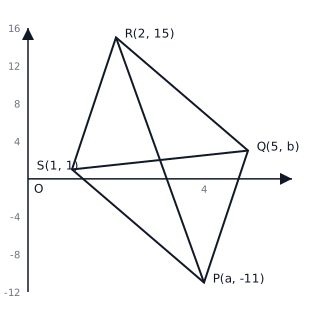
If the points P(a,−11)P(a, -11), Q(5,b)Q(5, b), R(2,15)R(2, 15), and S(1,1)S(1, 1) are the vertices of a parallelogram PQRSPQRS taken in order, find the values of aa and bb.

Coordinate representation of parallelogram PQRS with diagonals PR and QS.

Solution:

  1. In parallelogram PQRSPQRS, the diagonals PRPR and QSQS bisect each other.
  2. Therefore, Midpoint of PRPR = Midpoint of QSQS.
  3. Using the midpoint formula: (a+22,−11+152)=(5+12,b+12)\left( \frac{a + 2}{2}, \frac{-11 + 15}{2} \right) = \left( \frac{5 + 1}{2}, \frac{b + 1}{2} \right)
  4. Equating xx-coordinates: a+22=62  ⟹  a+2=6  ⟹  a=4\frac{a + 2}{2} = \frac{6}{2} \implies a + 2 = 6 \implies a = 4.
  5. Equating yy-coordinates: 42=b+12  ⟹  4=b+1  ⟹  b=3\frac{4}{2} = \frac{b + 1}{2} \implies 4 = b + 1 \implies b = 3. Final values: a=4,b=3a = 4, b = 3.

Explanation:

Since diagonals of a parallelogram bisect each other, their midpoints are identical. By setting the coordinates of the midpoints equal, we solve for the unknown variables aa and bb.

Problem 4:

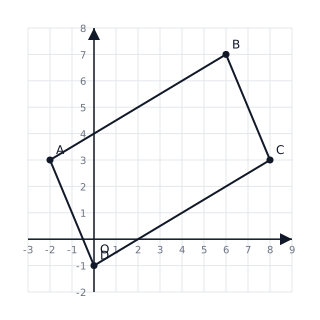
Given three vertices of a parallelogram ABCDABCD as A(−2,3)A(-2, 3), B(6,7)B(6, 7), and C(8,3)C(8, 3), find the coordinates of the vertex DD.

Plot of parallelogram ABCD with vertices at (-2,3), (6,7), (8,3) and (0,-1).

Solution:

  1. Let the coordinates of DD be (x,y)(x, y).
  2. Midpoint of AC=(−2+82,3+32)=(3,3)AC = \left( \frac{-2 + 8}{2}, \frac{3 + 3}{2} \right) = (3, 3).
  3. Midpoint of BD=(6+x2,7+y2)BD = \left( \frac{6 + x}{2}, \frac{7 + y}{2} \right).
  4. Since diagonals bisect each other, Midpoint of ACAC = Midpoint of BDBD.
  5. 6+x2=3  ⟹  6+x=6  ⟹  x=0\frac{6 + x}{2} = 3 \implies 6 + x = 6 \implies x = 0.
  6. 7+y2=3  ⟹  7+y=6  ⟹  y=−1\frac{7 + y}{2} = 3 \implies 7 + y = 6 \implies y = -1.
  7. The coordinates of DD are (0,−1)(0, -1).

Explanation:

We find the midpoint of the known diagonal ACAC first. Since the midpoint of BDBD must be the same point, we solve for xx and yy to locate DD.

Use coordinate geometry to find midpoints and missing vertex of parallelograms Class 9 Notes &…