
Review the key concepts, formulae, and examples before starting your quiz.
🔑Concepts
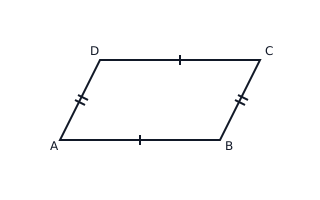
A quadrilateral is a parallelogram if its opposite sides are equal. In the figure, if and , then is a parallelogram.
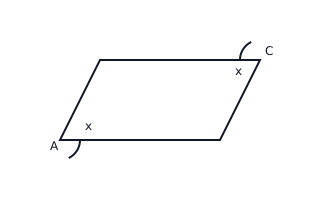
A quadrilateral is a parallelogram if its opposite angles are equal. This means if and , the figure must be a parallelogram.
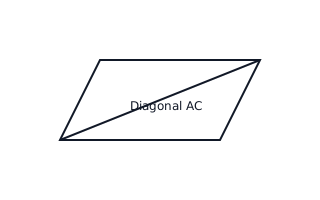
A diagonal of a parallelogram divides it into two congruent triangles. For example, by SSS or SAS criteria.
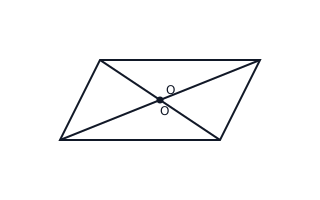
If the diagonals of a quadrilateral bisect each other, then it is a parallelogram. In the figure, and .
A quadrilateral is a parallelogram if one pair of opposite sides is both equal and parallel. This is a sufficient condition to prove the shape is a parallelogram.
📐Formulae
Opposite sides: and
Opposite angles: and
Sum of adjacent angles: or
Diagonal bisection: and (where is the intersection point)
Perimeter of a parallelogram: where and are adjacent sides
Area of a parallelogram:
💡Examples
Problem 1:
In a quadrilateral , , , and . Determine if is a parallelogram.
Solution:
Step 1: Use the angle sum property of a quadrilateral to find the fourth angle . Step 2: Substitute the known values into the equation: Step 3: Solve for : Step 4: Check the pairs of opposite angles. and (Equal). and (Equal). Since both pairs of opposite angles are equal, is a parallelogram.
Explanation:
This solution applies the theorem that a quadrilateral is a parallelogram if its opposite angles are equal. We first calculate the missing angle to verify the condition for both pairs.
Problem 2:
In quadrilateral , diagonals and intersect at . Given , , , and . Find the values of and that make a parallelogram.
Solution:
Step 1: For to be a parallelogram, the diagonals must bisect each other. This means and . Step 2: Set up the equation for diagonal : Step 3: Set up the equation for diagonal : Step 4: Therefore, for and , the diagonals bisect each other, making a parallelogram.
Explanation:
This example uses the diagonal bisection property. By equating the two segments of each diagonal, we ensure the intersection point is the midpoint for both, which is a necessary and sufficient condition for a parallelogram.
Problem 3:
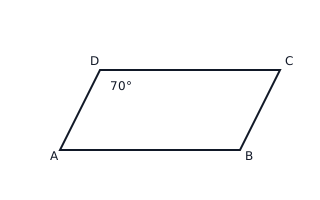
In the given figure, is a quadrilateral in which and . If , find .
Solution:
- Since one pair of opposite sides ( and ) are both equal and parallel, is a parallelogram.
- In a parallelogram, opposite angles are equal.
- Therefore, .
- Given , so .
Explanation:
This uses the property that if one pair of opposite sides is equal and parallel, the quadrilateral must be a parallelogram, and hence opposite angles are equal.
Problem 4:
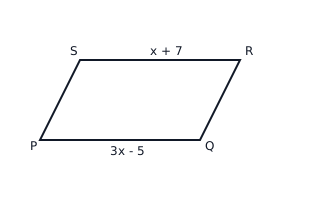
In parallelogram , the side is cm and is cm. Find the value of and the length of .
Solution:
- In a parallelogram, opposite sides are equal. Therefore, .
- cm.
Explanation:
We equate the expressions for opposite sides because opposite sides of a parallelogram are always equal in length.