
4-gons (Quadrilaterals) - Apply midpoint theorem and its converse in geometric proof problems
Review the key concepts, formulae, and examples before starting your quiz.
🔑Concepts
The Midpoint Theorem states that the line segment joining the midpoints of any two sides of a triangle is parallel to the third side and is equal to half of it. For , if and are midpoints of and , then and .
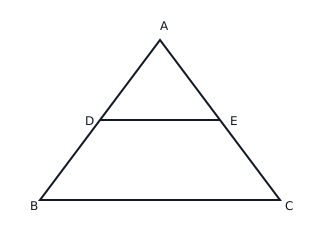
The Converse of the Midpoint Theorem states that a line drawn through the midpoint of one side of a triangle, parallel to another side, bisects the third side. In , if is the midpoint of and a line through parallel to meets at , then .
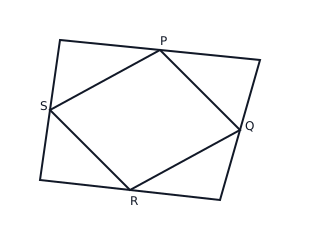
The quadrilateral formed by joining the midpoints of the sides of any quadrilateral taken in order is always a parallelogram. This is proved by applying the Midpoint Theorem to the triangles formed by the diagonals of the original quadrilateral.
The perimeter of the triangle formed by joining the midpoints of the sides of a triangle is exactly half the perimeter of the original triangle because each side of the inner triangle is the length of the corresponding parallel side of the outer triangle.
📐Formulae
If are mid-points of sides in , then:
In , if is mid-point of and , then .
where are mid-points.
For quadrilateral with mid-points , the sides of parallelogram are: and .
💡Examples
Problem 1:
In , and are the mid-points of sides and respectively. If , and , find the perimeter of .
Solution:
- By the Mid-point Theorem, joins mid-points of and , so .
- Similarly, joins mid-points of and , so .
- joins mid-points of and , so .
- Perimeter of .
Explanation:
This approach uses the Mid-point Theorem to determine each side of the inner triangle by taking half the length of the side of the original triangle to which it is parallel.
Problem 2:
In , is the median and is the mid-point of . is produced to meet at . Show that .
Solution:
- Draw a line meeting at .
- In , is the mid-point of (since is a median) and . By the Converse of Mid-point Theorem, is the mid-point of . Thus, .
- In , is the mid-point of and (as is part of ). By the Converse of Mid-point Theorem, is the mid-point of . Thus, .
- Combining the results: . Since , we have .
- Therefore, .
Explanation:
This solution utilizes a construction to create a new triangle where the Converse of the Mid-point Theorem can be applied twice to show that the segments on side are equal.
Problem 3:
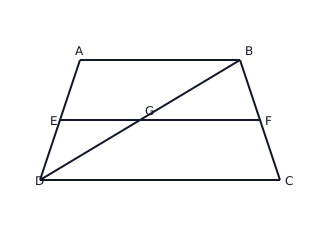
In the figure, is a trapezium in which , is a diagonal and is the mid-point of . A line is drawn through parallel to intersecting at . Show that is the mid-point of .
Solution:
Let intersect at point .
- In , is the mid-point of (Given).
- (Since ).
- By the Converse of Midpoint Theorem, is the mid-point of .
Now, in :
- is the mid-point of (Proved above).
- (Since and , so ).
- By the Converse of Midpoint Theorem, is the mid-point of .
Explanation:
We use the converse of the midpoint theorem twice: first in the triangle involving the left side and diagonal to locate the diagonal's midpoint, then in the triangle involving the right side and diagonal to prove is the midpoint.
Problem 4:
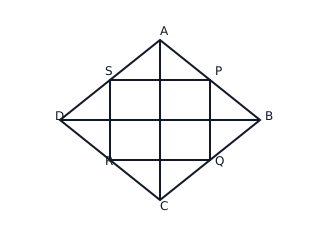
is a rhombus and and are the mid-points of the sides and respectively. Show that the quadrilateral is a rectangle.
Solution:
- In , and are mid-points of and . By Midpoint Theorem, and .
- Similarly, in , and . Thus, and , so is a parallelogram.
- In a rhombus, diagonals and intersect at (say at ).
- Since and , the angle between and will be the same as the angle between and .
- Therefore, .
- A parallelogram with one angle is a rectangle. Hence, is a rectangle.
Explanation:
Joining midpoints of any quadrilateral forms a parallelogram. Since the diagonals of a rhombus are perpendicular, the sides of the midpoint parallelogram (which are parallel to the diagonals) must also be perpendicular, making it a rectangle.