
Review the key concepts, formulae, and examples before starting your quiz.
🔑Concepts
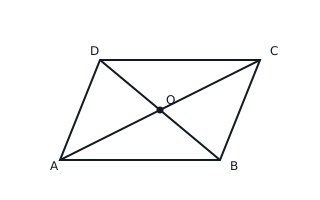
Central Symmetry in Parallelograms: A parallelogram possesses point symmetry (central symmetry) about the point of intersection of its diagonals. Every point on the boundary has a corresponding point such that the intersection point is the midpoint of .
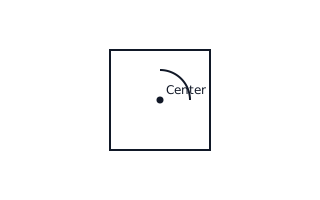
Rotational Symmetry: A square has rotational symmetry of order 4 about its center (point of intersection of diagonals), while a rectangle and a rhombus have rotational symmetry of order 2.
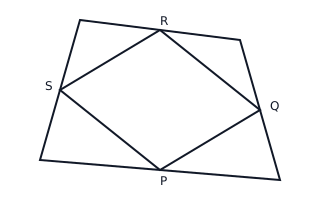
Mid-point Theorem Transformation: If you join the mid-points of the sides of any quadrilateral, the resulting figure is always a parallelogram. This transformation simplifies complex quadrilateral properties into known parallelogram properties.
Reflection Symmetry: Line symmetry occurs in specific quadrilaterals. An isosceles trapezoid has one line of symmetry (joining midpoints of parallel sides), while a rhombus has two (its diagonals).
📐Formulae
💡Examples
Problem 1:
In a quadrilateral , the angles are in the ratio . Find all the angles of the quadrilateral.
Solution:
Let the angles be , , , and . By the angle sum property of a quadrilateral: The angles are:
Explanation:
We use the property that the sum of all interior angles in any quadrilateral is to solve for the unknown variable .
Problem 2:
Prove that the diagonals of a parallelogram divide it into four triangles of equal area and demonstrate central symmetry.
Solution:
Let be a parallelogram with diagonals and intersecting at . Since diagonals bisect each other, and . In and :
- (Diagonals bisect each other)
- (Diagonals bisect each other)
- (Vertically opposite angles) (by SAS congruence). Similarly, . The point acts as the center of symmetry because every point on side has a corresponding point on side such that is the midpoint of .
Explanation:
The bisection of diagonals is the geometric basis for central symmetry in parallelograms. A rotation about maps the parallelogram onto itself.
Problem 3:
A quadrilateral is formed by joining the mid-points of the sides of a rectangle . Identify the type of quadrilateral formed.
Solution:
Let be the mid-points of sides of rectangle . Join . In , and (Mid-point theorem). In , and . Thus, and , making a parallelogram. Since is a rectangle, its diagonals are equal (). Using the mid-point theorem for , we find . Since , then . A parallelogram with all sides equal is a rhombus.
Explanation:
The mid-point theorem is applied to show that the resulting figure is a parallelogram, and the specific properties of the parent shape (rectangle diagonals being equal) determine that the result is a rhombus.
Problem 4:
Show that the quadrilateral formed by the internal angle bisectors of a parallelogram is a rectangle.
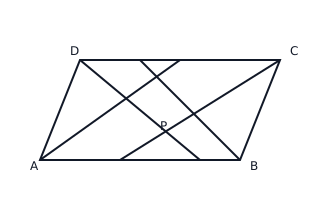
Solution:
Similarly, all interior angles of the quadrilateral are , making it a rectangle.
Explanation:
Since the sum of adjacent angles in a parallelogram is , the sum of their halves is . The angle bisectors form triangles where the third angle must be . By symmetry, this applies to all four intersections.
Problem 5:
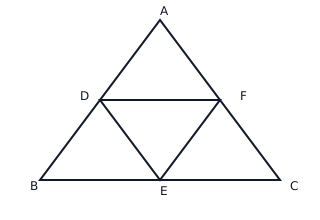
In , , , and are the mid-points of sides , , and respectively. Show that is divided into four congruent triangles by joining , , and .
Solution:
By the Mid-point Theorem: In quadrilateral , and , so is a parallelogram. The diagonal divides it into two congruent triangles: . Similarly, and . Thus, all four triangles are congruent.
Explanation:
Joining midpoints creates four smaller triangles. Using the Mid-point Theorem, we identify three parallelograms within the large triangle. Since a diagonal divides a parallelogram into two congruent triangles, all four small triangles are proved congruent to the central one.