
Review the key concepts, formulae, and examples before starting your quiz.
🔑Concepts
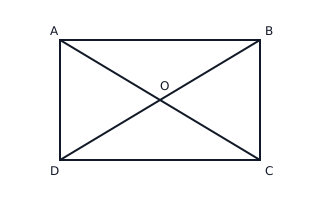
A rectangle is a parallelogram where every interior angle is a right angle (). Its opposite sides are equal and parallel, and its diagonals are equal in length and bisect each other.
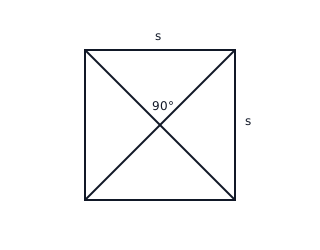
A square is a special type of rectangle where all four sides are equal. It possesses all properties of a rectangle and a rhombus. Its diagonals are equal, bisect each other at right angles (), and bisect the vertex angles.
In a rectangle, the diagonals are equal. If and are diagonals of rectangle , then .
In a square, the angle between the diagonals is always , making them perpendicular bisectors of each other.
📐Formulae
💡Examples
Problem 1:
In a rectangle , the diagonals and intersect at . If and , find the value of .
Solution:
In a rectangle, diagonals are equal and bisect each other. Therefore, and their halves are also equal. This means .
Explanation:
Since diagonals of a rectangle bisect each other and are equal in length, the segments from the intersection point to any vertex are equal.
Problem 2:
Find the length of the diagonal of a square whose side is cm.
Solution:
Given side cm. The formula for the diagonal of a square is . If we use :
Explanation:
The diagonal of a square forms a right-angled triangle with two sides. Using Pythagoras theorem: , hence .
Problem 3:
The perimeter of a rectangle is cm. If its length is cm, calculate its area.
Solution:
Given Perimeter cm and length cm. Now, Area :
Explanation:
First, use the perimeter formula to find the unknown breadth, then use the area formula.
Problem 4:
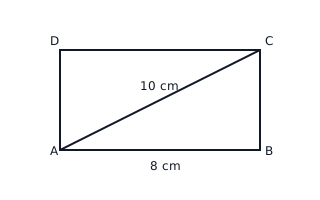
In the given rectangle , the length is cm and the diagonal is cm. Find the breadth of the rectangle.
Solution:
In rectangle , . Thus, is a right-angled triangle. Using Pythagoras theorem:
Explanation:
Since all angles in a rectangle are , we can use the Pythagorean theorem on the triangle formed by the length, breadth, and diagonal.
Problem 5:
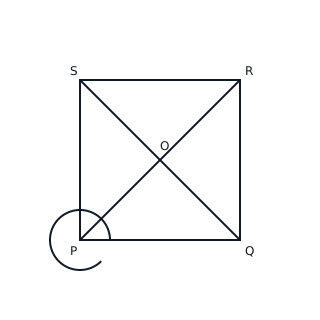
Square has diagonals intersecting at . If , find the value of .
Solution:
In a square, the diagonals bisect the vertex angles. Since each vertex angle is , the diagonal bisects it into two angles. Therefore, .
Explanation:
Diagonals of a square are angle bisectors of the interior angles, so the angle between a side and a diagonal is always .