krit.club logo

Quadrilaterals - Angles in a Quadrilateral

Grade 8CBSE

Review the key concepts, formulae, and examples before starting your quiz.

🔑Concepts

•

A quadrilateral is a plane figure bounded by four line segments. It has four vertices, four sides, and four interior angles.
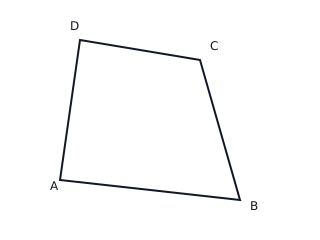
A general quadrilateral ABCD with four sides and four vertices.
•

The Angle Sum Property of a quadrilateral states that the sum of all four interior angles is exactly 360∘360^\circ. This can be proven by dividing the quadrilateral into two triangles using a diagonal.
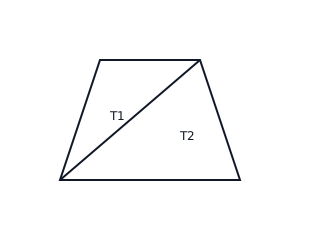
A quadrilateral divided by a diagonal into two triangles, each summing to 180 degrees.
•

Adjacent angles in a quadrilateral are two angles that share a common side, while opposite angles are those that do not share a common side.
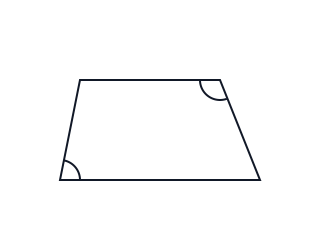
Quadrilateral showing opposite angles marked with arcs.
•

A convex quadrilateral is one where all interior angles are less than 180∘180^\circ. A concave quadrilateral has at least one interior angle greater than 180∘180^\circ (a reflex angle), yet the total sum remains 360∘360^\circ.

📐Formulae

Sum of interior angles of a quadrilateral=360∘\text{Sum of interior angles of a quadrilateral} = 360^\circ

∠A+∠B+∠C+∠D=360∘\angle A + \angle B + \angle C + \angle D = 360^\circ

Sum of interior angles of an n-sided polygon=(n−2)×180∘\text{Sum of interior angles of an } n\text{-sided polygon} = (n - 2) \times 180^\circ

Measure of each angle in a regular n-sided polygon=(n−2)×180∘n\text{Measure of each angle in a regular } n\text{-sided polygon} = \frac{(n - 2) \times 180^\circ}{n}

💡Examples

Problem 1:

Three angles of a quadrilateral are 75∘75^\circ, 90∘90^\circ, and 75∘75^\circ. Find the fourth angle.

Solution:

Let the fourth angle be xx. According to the angle sum property: 75∘+90∘+75∘+x=360∘75^\circ + 90^\circ + 75^\circ + x = 360^\circ First, add the given angles: 7590+75240\begin{array}{r} 75 \\ 90 \\ + 75 \\ \hline 240 \end{array} So, 240∘+x=360∘240^\circ + x = 360^\circ x=360∘−240∘x = 360^\circ - 240^\circ 360−240120\begin{array}{r} 360 \\ - 240 \\ \hline 120 \end{array} Therefore, x=120∘x = 120^\circ.

Explanation:

We use the Angle Sum Property which states that all interior angles must add up to 360∘360^\circ. By subtracting the sum of the three known angles from 360∘360^\circ, we find the unknown angle.

Problem 2:

The angles of a quadrilateral are in the ratio 3:5:9:133:5:9:13. Find all the angles of the quadrilateral.

Solution:

Let the common ratio multiplier be xx. Therefore, the angles are 3x3x, 5x5x, 9x9x, and 13x13x. By the angle sum property: 3x+5x+9x+13x=360∘3x + 5x + 9x + 13x = 360^\circ 30x=360∘30x = 360^\circ x=360∘30=12∘x = \frac{360^\circ}{30} = 12^\circ Now, calculate each angle: 3x=3×12∘=36∘3x = 3 \times 12^\circ = 36^\circ 5x=5×12∘=60∘5x = 5 \times 12^\circ = 60^\circ 9x=9×12∘=108∘9x = 9 \times 12^\circ = 108^\circ 13x=13×12∘=156∘13x = 13 \times 12^\circ = 156^\circ

Explanation:

When angles are given in a ratio, we represent them as terms of xx, sum them to 360∘360^\circ, solve for xx, and then substitute xx back into each term to find the individual angle measures.

Problem 3:

In a quadrilateral ABCDABCD, ∠A=(x+10)∘\angle A = (x + 10)^\circ, ∠B=(2x+5)∘\angle B = (2x + 5)^\circ, ∠C=(x−15)∘\angle C = (x - 15)^\circ, and ∠D=(x+20)∘\angle D = (x + 20)^\circ. Find the value of xx.

Solution:

Sum of angles =360∘= 360^\circ (x+10)+(2x+5)+(x−15)+(x+20)=360(x + 10) + (2x + 5) + (x - 15) + (x + 20) = 360 Grouping like terms: (x+2x+x+x)+(10+5−15+20)=360(x + 2x + x + x) + (10 + 5 - 15 + 20) = 360 5x+20=3605x + 20 = 360 5x=360−205x = 360 - 20 5x=3405x = 340 x=3405x = \frac{340}{5} x=68x = 68

Explanation:

We set up an algebraic equation based on the Angle Sum Property. By combining the coefficients of xx and the constant terms, we solve for the variable xx.

Problem 4:

In the given quadrilateral PQRSPQRS, find the value of xx if three of its exterior angles are as shown in the diagram.
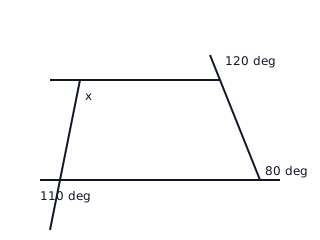
A quadrilateral with three exterior angles labeled.

Solution:

  1. Find the interior angles using the linear pair property: Interior ∠P=180∘−110∘=70∘\angle P = 180^\circ - 110^\circ = 70^\circ Interior ∠Q=180∘−80∘=100∘\angle Q = 180^\circ - 80^\circ = 100^\circ Interior ∠R=180∘−120∘=60∘\angle R = 180^\circ - 120^\circ = 60^\circ
  2. Let the fourth interior angle be xx.
  3. Using Angle Sum Property: 70∘+100∘+60∘+x=360∘70^\circ + 100^\circ + 60^\circ + x = 360^\circ 230∘+x=360∘230^\circ + x = 360^\circ x=360∘−230∘=130∘x = 360^\circ - 230^\circ = 130^\circ

Therefore, the value of xx is 130∘130^\circ.

Explanation:

We first convert the given exterior angles to interior angles because the sum of interior angles of any quadrilateral is always 360∘360^\circ.

Problem 5:

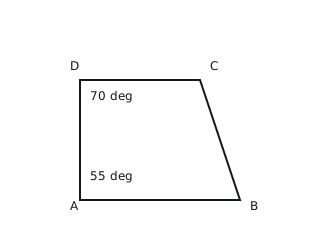
In quadrilateral ABCDABCD, sides ABAB and DCDC are parallel. If ∠A=55∘\angle A = 55^\circ and ∠D=70∘\angle D = 70^\circ, find ∠B\angle B and ∠C\angle C.

Trapezium with parallel sides AD and BC marked.

Solution:

  1. Since AB∥DCAB \parallel DC, the adjacent angles between the parallel lines (consecutive interior angles) are supplementary.
  2. ∠A+∠D\angle A + \angle D does not apply here as they are on the same transversal ADAD. ∠A+∠D=55∘+70∘=125∘\angle A + \angle D = 55^\circ + 70^\circ = 125^\circ.
  3. For AB∥DCAB \parallel DC, ∠A+∠D\angle A + \angle D are interior angles on the same side of transversal ADAD only if ADAD was the parallel pair. Here AB∥DCAB \parallel DC, so ∠A+∠D\angle A + \angle D are not necessarily 180∘180^\circ unless it's a specific shape.
  4. However, in a trapezoid where AB∥DCAB \parallel DC, ∠A+∠D=180∘\angle A + \angle D = 180^\circ and ∠B+∠C=180∘\angle B + \angle C = 180^\circ is incorrect. The correct relation is ∠A+∠D=180∘\angle A + \angle D = 180^\circ (if ADAD is transversal) and ∠B+∠C=180∘\angle B + \angle C = 180^\circ.
  5. Given ∠A=55∘\angle A = 55^\circ, then ∠D=180∘−55∘=125∘\angle D = 180^\circ - 55^\circ = 125^\circ. But the problem states ∠D=70∘\angle D = 70^\circ. This implies the parallel sides are ADAD and BCBC.
  6. If AD∥BCAD \parallel BC, then ∠A+∠B=180∘  ⟹  ∠B=180∘−55∘=125∘\angle A + \angle B = 180^\circ \implies \angle B = 180^\circ - 55^\circ = 125^\circ.
  7. Also ∠D+∠C=180∘  ⟹  ∠C=180∘−70∘=110∘\angle D + \angle C = 180^\circ \implies \angle C = 180^\circ - 70^\circ = 110^\circ.
  8. Check: 55+125+110+70=360∘55 + 125 + 110 + 70 = 360^\circ.

Explanation:

When two sides of a quadrilateral are parallel, the angles interior to the parallel lines on the same transversal sum to 180∘180^\circ.