
Review the key concepts, formulae, and examples before starting your quiz.
🔑Concepts
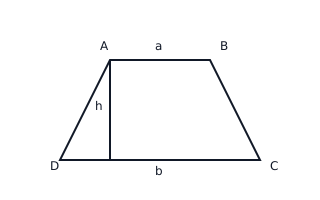
A Trapezium is a quadrilateral with at least one pair of parallel sides. In an isosceles trapezium, the non-parallel sides are equal, and the base angles are equal.
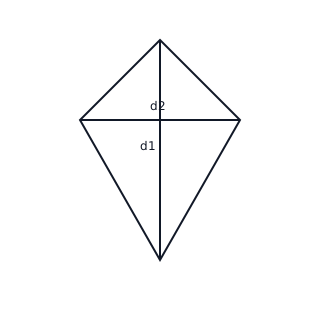
A Kite is a quadrilateral with two pairs of equal-length sides that are adjacent to each other. The diagonals of a kite intersect at , and one diagonal bisects the other.
The area of a trapezium is calculated as half the sum of the parallel sides multiplied by the perpendicular distance (height) between them:
The area of a kite is calculated as half the product of its diagonals:
📐Formulae
💡Examples
Problem 1:
Find the area of a trapezium whose parallel sides are and and the distance between them is .
Solution:
Given: , , and . Using the formula:
Explanation:
To find the area of a trapezium, add the lengths of the parallel sides, multiply by the height (perpendicular distance), and then divide by 2.
Problem 2:
In a kite , the lengths of the diagonals are and . Calculate its area.
Solution:
Given: and . Using the area formula for a kite:
Explanation:
The area of a kite is half the product of the lengths of its diagonals.
Problem 3:
In an isosceles trapezium , if and , find the remaining angles.
Solution:
Since is an isosceles trapezium with : 1. Base angles are equal, so . 2. Adjacent angles between parallel sides are supplementary: 3. Similarly, . The calculation for the total sum is:
Explanation:
In an isosceles trapezium, angles sharing the same base are equal, and the sum of angles on a non-parallel side is .
Problem 4:
The area of a trapezium is , the distance between two parallel sides is and one of the parallel sides is . Find the other parallel side.
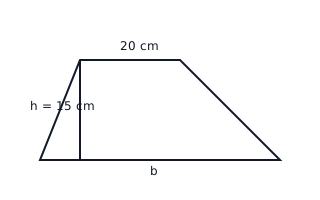
Solution:
Explanation:
We use the area formula for a trapezium. Given Area (), height (), and one side (), we solve the linear equation for the unknown side .
Problem 5:
In kite , the length of diagonal and the area is . Find the length of the other diagonal .
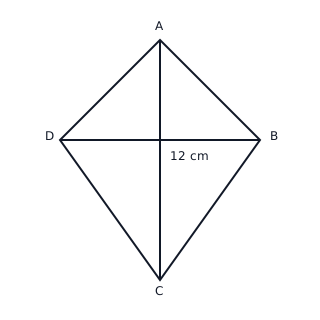
Solution:
Explanation:
The area of a kite depends on the product of its diagonals. By substituting the given area and one diagonal into the formula, we find the second diagonal.