
Review the key concepts, formulae, and examples before starting your quiz.
🔑Concepts
A quadrilateral is a polygon with four sides, four vertices, and four angles. The sum of the interior angles of a quadrilateral is always . This property can be derived by dividing the quadrilateral into two triangles.
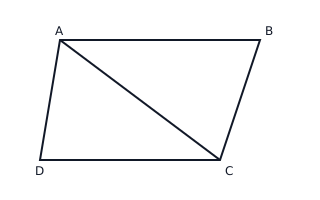
A Parallelogram is a special quadrilateral where opposite sides are parallel and equal. Its opposite angles are equal, and its diagonals bisect each other.

A Rhombus is a parallelogram with all four sides of equal length. Its diagonals are perpendicular bisectors of each other, meaning they intersect at .

A Trapezium is a quadrilateral with at least one pair of parallel sides. If the non-parallel sides are equal, it is called an Isosceles Trapezium.
📐Formulae
💡Examples
Problem 1:
Three angles of a quadrilateral are , , and . Find the fourth angle .
Solution:
Sum of angles = . So, . .
Explanation:
We use the Angle Sum Property of a quadrilateral which states that the sum of all four interior angles is equal to .
Problem 2:
Find the number of sides of a regular polygon whose each exterior angle has a measure of .
Solution:
Let the number of sides be . We know that . .
Explanation:
For any regular polygon, the product of the number of sides and the measure of each exterior angle is always .
Problem 3:
In a parallelogram , the adjacent angles and are in the ratio . Find the measure of all angles.
Solution:
Let and . In a parallelogram, adjacent angles are supplementary: . . . . Opposite angles are equal, so and .
Explanation:
In a parallelogram, adjacent angles sum to (they are consecutive interior angles between parallel lines) and opposite angles are equal.
Problem 4:
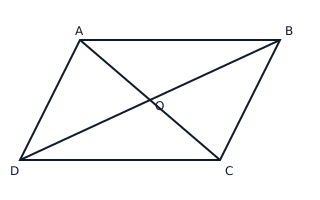
In the given parallelogram , find the values of and if the diagonals and intersect at , given , , , and .
Solution:
- In a parallelogram, diagonals bisect each other.
- Therefore, and .
- From , we have:
- From , we have: Final Answer: , .
Explanation:
We use the property that diagonals of a parallelogram bisect each other to set up two linear equations and solve for the unknown variables.
Problem 5:
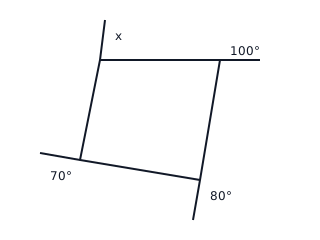
Find the value of in the following quadrilateral where three exterior angles are , , and .
Solution:
- The sum of the exterior angles of any polygon is always .
- Let the fourth exterior angle be .
- Final Answer: .
Explanation:
This solution applies the Exterior Angle Sum Property, which states that the sum of exterior angles of any convex polygon is .