
Review the key concepts, formulae, and examples before starting your quiz.
🔑Concepts
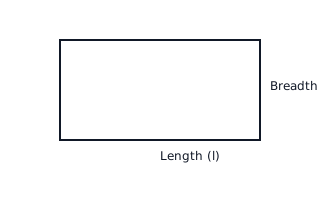
The perimeter of a rectangle is the total distance around its edge, calculated by summing twice the length and twice the breadth: . Its area is the region enclosed, given by .
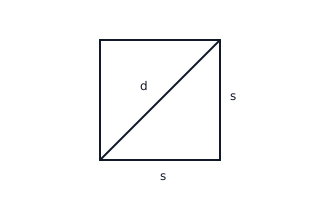
A square is a special rectangle where all sides () are equal. The perimeter is and the area is . The diagonal () divides it into two right-angled triangles, where and .
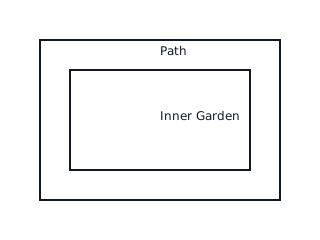
When a path is built around or inside a rectangular region, the area of the path is the difference between the area of the outer rectangle and the area of the inner rectangle.
Units of Measurement: Perimeter is measured in linear units like or . Area is measured in square units like or . For large land areas, .
📐Formulae
💡Examples
Problem 1:
A rectangular playground is long and wide. Find the cost of fencing it at the rate of per meter.
Solution:
- Identify dimensions: Length and Breadth .
- Calculate Perimeter (): .
- Calculate Cost: .
- Final Calculation: .
Explanation:
To find the cost of fencing, we must find the total length of the boundary (Perimeter). We then multiply this distance by the cost per meter provided in the problem.
Problem 2:
The area of a square plot is . Find its perimeter and the length of its diagonal.
Solution:
- Given: .
- Find the Side (): .
- Calculate Perimeter (): .
- Calculate Diagonal (): .
Explanation:
Starting with the area, we determine the length of one side by taking the square root. Once the side is known, we can easily find the perimeter by multiplying by 4 and the diagonal by multiplying the side by .
Problem 3:
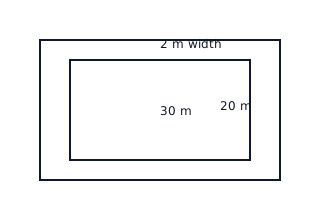
A path of width is built outside and around a rectangular park of length and breadth . Find the area of the path.
Solution:
- Length of inner park
- Breadth of inner park
- Area of inner park =
- The path is wide on all sides. Outer Length Outer Breadth
- Area of outer rectangle =
- Area of path = Outer Area - Inner Area Area of path =
Explanation:
To find the area of the path, we calculate the area of the larger rectangle (including the path) and subtract the area of the smaller rectangle (the park). Adding the width twice to each dimension accounts for the path on both ends.
Problem 4:
Calculate the area of a square whose diagonal is .
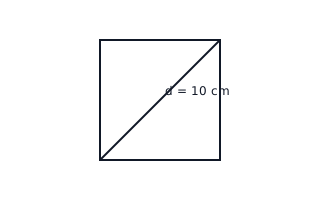
Solution:
- Given Diagonal
- Formula for Area of a square using diagonal is
Explanation:
When the diagonal of a square is known, we can find the area directly without finding the side length first by using the formula derived from the Pythagorean theorem.