
Review the key concepts, formulae, and examples before starting your quiz.
🔑Concepts
A parallelogram is a quadrilateral with two pairs of parallel sides. The area is calculated by multiplying the base () by the corresponding perpendicular height (). Any side can be chosen as the base, provided the height is measured from that specific base to the opposite side.
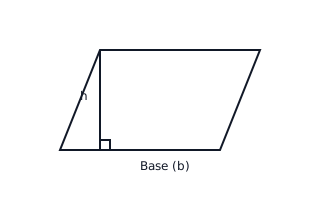
A triangle's area is exactly half the area of a parallelogram with the same base and height. The formula is . For a right-angled triangle, the two sides containing the right angle act as the base and the height.
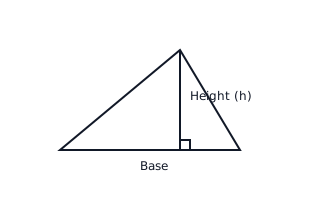
In a parallelogram, if we know the area and one side (base), the corresponding height can be found using . Similarly, for a triangle, the height is found using .
When calculating area, ensure all units are consistent (e.g., all dimensions in cm or all in m). If the base is in cm and height is in mm, convert one to match the other before multiplying.
📐Formulae
Area of a Parallelogram =
Area of a Triangle =
Base of a Parallelogram =
Height of a Parallelogram =
Base of a Triangle =
Height of a Triangle =
💡Examples
Problem 1:
A parallelogram has a base of and a corresponding height of . Find its area. If another side of the parallelogram is , find the height corresponding to that side.
Solution:
- Find the area using the first base and height:
- Use the area to find the second height for the side :
Explanation:
First, calculate the total area using the known pair of base and height. Since the area of the parallelogram remains constant regardless of which side is used as the base, use that area value to solve for the missing height corresponding to the second side.
Problem 2:
The area of a triangle is . If the base of the triangle is , calculate its altitude (height).
Solution:
- Write down the area formula for a triangle:
- Substitute the given values:
- Solve for Height:
Explanation:
Plug the known area and base into the triangle area formula. Multiply the area by to remove the fraction, then divide by the base to find the perpendicular height.
Problem 3:
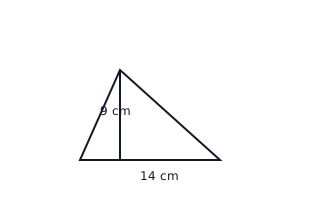
Find the area of a triangle whose base is and the corresponding altitude is .
Solution:
Explanation:
We use the standard triangle area formula. Half of the base () is , which when multiplied by the height () gives .
Problem 4:
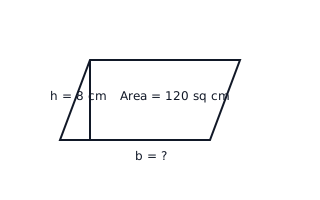
The area of a parallelogram is . If its height is , find the length of the corresponding base.
Solution:
Explanation:
To find the base of a parallelogram when area and height are given, divide the area by the height.