
Review the key concepts, formulae, and examples before starting your quiz.
🔑Concepts
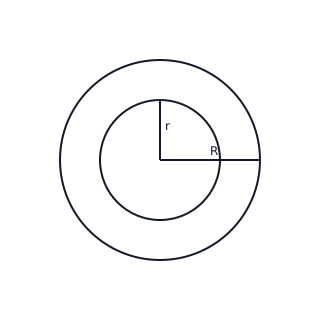
The area of a circular ring (annulus) is the difference between the area of the larger outer circle and the smaller inner circle. If is the outer radius and is the inner radius, the area is .
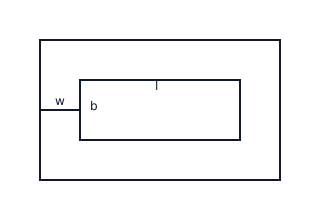
A rectangular path built around a rectangle increases both the length and the breadth. If a path of width is built outside a rectangle of length and breadth , the new dimensions are and .
Cross paths are two rectangular strips that intersect inside a rectangle. To find their area, sum the areas of the two strips and subtract the area of the central square common to both paths to avoid double counting: Area .
When a path is built inside a rectangle, the dimensions of the inner region are found by subtracting twice the width from the outer dimensions: and .
📐Formulae
Area of a Circle =
Area of a Ring = (where is the outer radius and is the inner radius)
Width of a Ring =
Area of a Rectangular Path = (where are outer dimensions and are inner dimensions)
Area of Cross Paths = (where is the uniform width of the paths crossing a rectangle of length and breadth )
💡Examples
Problem 1:
A circular park has a radius of m. A uniform path of width m is constructed outside the park. Find the area of the path. (Take )
Solution:
- Inner radius of the park () = m.
- Width of the path = m.
- Outer radius () = m.
- Area of the path = Area of outer circle - Area of inner circle
- Area =
- Area =
- Using , Area =
- Area = .
Explanation:
To find the area of the path built outside, we first determine the outer radius by adding the path width to the inner radius. Then, we use the formula for the area of a ring by subtracting the smaller circle's area from the larger one.
Problem 2:
A rectangular lawn measures m by m. A path m wide is constructed all around it on the inside. Find the area of the path.
Solution:
- Outer length () = m, Outer breadth () = m.
- Width of the path () = m.
- Inner length () = m.
- Inner breadth () = m.
- Area of outer lawn = .
- Area of inner rectangular portion = .
- Area of the path = Outer Area - Inner Area
- Area of path = .
Explanation:
Since the path is inside the lawn, we subtract twice the width from both the length and breadth to find the dimensions of the inner rectangle. The area of the path is the difference between the total area of the lawn and the area of the remaining inner portion.
Problem 3:
Two cross-roads, each of width m, run at right angles through the centre of a rectangular park of length m and breadth m and parallel to its sides. Find the area of the roads.
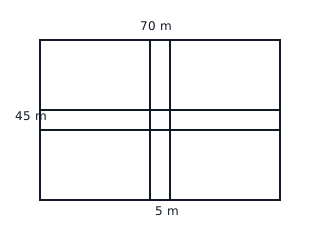
Solution:
- Area of the road parallel to the length
- Area of the road parallel to the breadth
- Area of the common central square
- Total area of roads
Explanation:
The paths overlap at the center of the park. By calculating the areas of the two rectangular strips, we count the middle square twice. Thus, we must subtract it once.
Problem 4:
A circular pond has a diameter of m. A m wide stone walk is built around it. Find the cost of gravelling the walk at Rs per square metre. (Take )
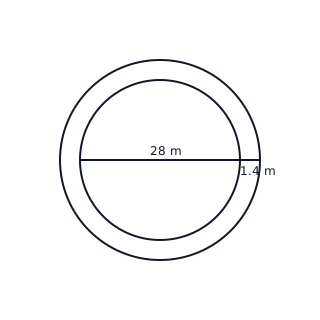
Solution:
- Inner radius
- Outer radius
- Area of the walk
- Area
- Cost Total Cost = Rs 6468
Explanation:
To find the area of the path around a circular pond, we find the area of the larger circle (pond + path) and subtract the area of the pond. Finally, multiply the resulting area by the rate per square metre.