
Review the key concepts, formulae, and examples before starting your quiz.
🔑Concepts
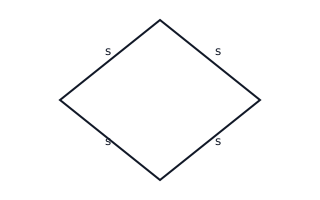
A rhombus is a special type of parallelogram where all four sides are of equal length. Its opposite sides are parallel, and opposite angles are equal.
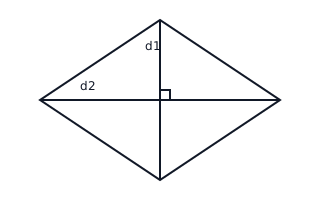
The diagonals of a rhombus, denoted as and , bisect each other at right angles (). This property allows the area to be calculated as half the product of the diagonals.
The area of a rhombus can also be calculated using its base () and its vertical height or altitude (), just like any other parallelogram: .
Because the diagonals bisect each other at right angles, each side of the rhombus forms the hypotenuse of a right-angled triangle with legs and .
📐Formulae
💡Examples
Problem 1:
Calculate the area of a rhombus if the lengths of its diagonals are and .
Solution:
- Identify the given diagonal lengths: and .
- Use the area formula for a rhombus: .
- Substitute the values into the formula: .
- Calculate the product: .
Explanation:
To find the area when both diagonals are given, we multiply the diagonals together and divide the result by 2.
Problem 2:
The area of a rhombus is and its altitude is . Find the length of each side.
Solution:
- Given: and .
- Use the parallelogram formula: .
- Substitute the known values: .
- Solve for the base: .
- Conclusion: Since all sides of a rhombus are equal, each side is .
Explanation:
Since a rhombus is also a parallelogram, dividing its total area by its perpendicular height (altitude) gives the length of the base, which is equal to its side length.
Problem 3:
Find the area of a rhombus where one side measures and the altitude is .
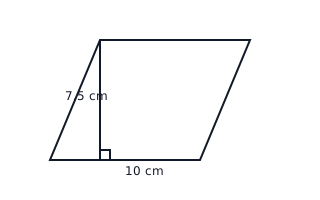
Solution:
Given: Base () = Altitude () =
Using the formula:
The area of the rhombus is .
Explanation:
When the base and altitude are known, we treat the rhombus as a parallelogram to find the area.
Problem 4:
One diagonal of a rhombus is and its area is . Find the length of the other diagonal.
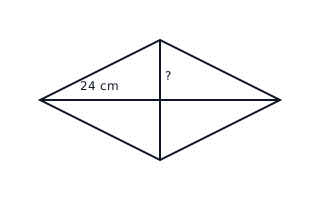
Solution:
Given: Area =
Using the formula:
The length of the other diagonal is .
Explanation:
We use the diagonal-based area formula and solve for the unknown variable .