
Review the key concepts, formulae, and examples before starting your quiz.
🔑Concepts
A triangle is a three-sided polygon, the simplest closed figure made of line segments. It has three vertices, three sides, and three angles.
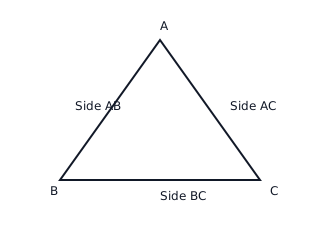
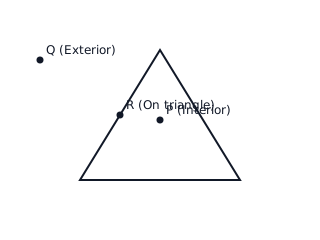
The interior of a triangle consists of all points enclosed by the three sides. Points can lie in the interior, in the exterior, or on the boundary (the sides) of the triangle.
Triangles can be classified by their sides: Scalene (all sides different), Isosceles (at least two sides equal), or Equilateral (all three sides equal).
Triangles can be classified by their angles: Acute-angled (all angles ), Right-angled (one angle ), or Obtuse-angled (one angle ).
📐Formulae
💡Examples
Problem 1:
In , the measures of two angles are and . Find the measure of the third angle .
Solution:
Step 1: Use the Angle Sum Property of a triangle, which states that . Step 2: Substitute the known values: . Step 3: Add the known angles: . Step 4: Subtract from both sides: .
Explanation:
We apply the property that all interior angles of a triangle must add up to to find the unknown value.
Problem 2:
Check if it is possible to form a triangle with side lengths cm, cm, and cm.
Solution:
Step 1: Identify the three side lengths: , , and . Step 2: Apply the Triangle Inequality Property, which states that the sum of any two sides must be greater than the third side. Step 3: Check : . Since is not greater than (), the condition fails. Step 4: Conclusion: A triangle cannot be formed with these lengths.
Explanation:
According to the Triangle Inequality Property, the sum of the two shorter sides () must be greater than the longest side (). Since , the sides cannot meet to form a closed triangle.
Problem 3:
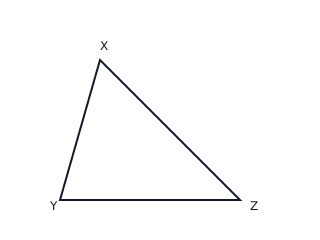
Identify the sides, vertices, and angles of the given triangle .
Solution:
Explanation:
A triangle is named by its vertices. The line segments forming the triangle are its sides, and the space between the meeting segments at the vertices forms the angles.
Problem 4:
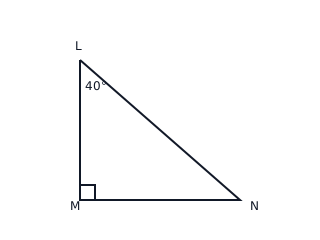
In the right-angled triangle shown below, if and , calculate the measure of .
Solution:
Explanation:
Using the Angle Sum Property of a triangle, the sum of all interior angles is always . We subtract the sum of the two known angles from to find the third.