
Review the key concepts, formulae, and examples before starting your quiz.
🔑Concepts
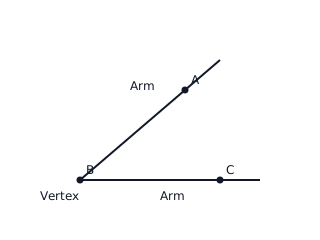
An angle is formed when two rays originate from a common starting point. This common point is called the vertex, and the two rays are known as the arms or sides of the angle. In the notation , the middle letter represents the vertex.
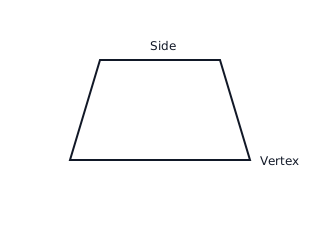
A polygon is a closed figure made up entirely of line segments. The line segments forming the polygon are called its sides. The point where any two sides meet is called a vertex.
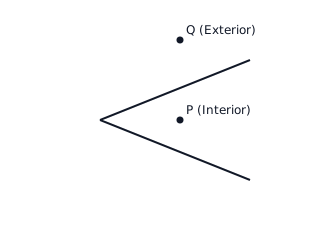
The interior of an angle is the region between the arms that extends infinitely. Any point located inside this space is said to be in the interior, while points outside the arms are in the exterior. Points on the rays themselves are said to be 'on the angle'.
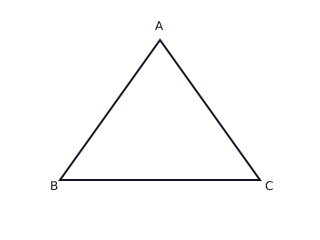
Adjacent sides of a polygon are any two sides that share a common vertex. For example, in a triangle , the sides and are adjacent because they meet at vertex .
📐Formulae
💡Examples
Problem 1:
Given an angle named , identify the vertex and the arms of the angle.
Solution:
Step 1: Identify the middle letter in the angle notation . The middle letter is , so the Vertex is . Step 2: The arms are the rays that start from the vertex and pass through the other two points and . Therefore, the Arms are Ray and Ray .
Explanation:
In geometric notation for angles, the vertex is always placed in the center of the three-letter name. The arms originate from this vertex point.
Problem 2:
A triangle is named . List all the sides and all the vertices of this triangle.
Solution:
Step 1: Identify the vertices. The vertices are the individual points that define the corners of the triangle: . Step 2: Identify the sides. The sides are the line segments connecting these points: , , and .
Explanation:
A triangle is a polygon with three sides and three vertices. Each side is a line segment connecting two consecutive vertices.
Problem 3:
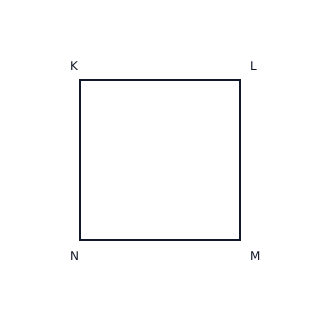
Observe the quadrilateral . Name all the pairs of opposite sides and all the pairs of opposite angles.
Solution:
Opposite sides: and . Opposite angles: and .
Explanation:
Opposite sides in a quadrilateral are the sides that do not meet at a common vertex. Opposite angles are the angles at vertices that are not connected by a single side.
Problem 4:
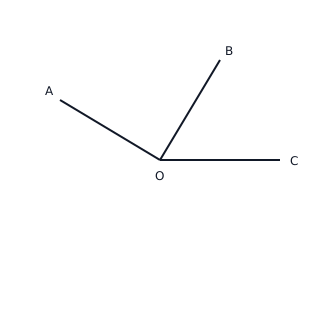
In the given figure, identify three angles that have point as their common vertex.
Solution:
The three angles are , , and .
Explanation:
An angle is formed by any two rays meeting at a point. Here, rays , , and all meet at . We can pair them as , , and to form three distinct angles.