
Review the key concepts, formulae, and examples before starting your quiz.
🔑Concepts
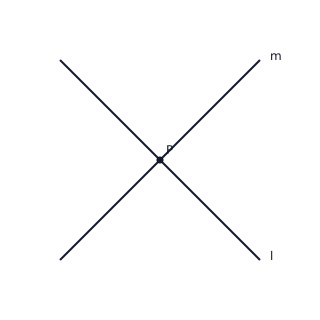
Intersecting Lines: Two distinct lines are called intersecting lines if they have a common point. This common point is called the point of intersection. For example, the letter 'X' is formed by two intersecting line segments.
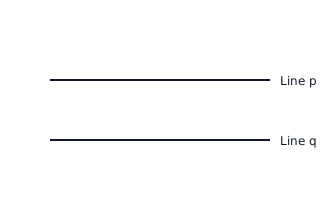
Parallel Lines: Lines in a plane that do not meet, however far they are extended, are called parallel lines. The distance between them remains constant throughout. Examples include the tracks of a railway line or the opposite edges of a ruler.
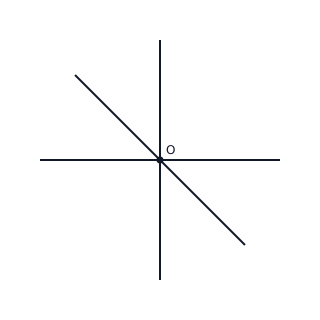
Concurrent Lines: When three or more lines in a plane pass through the same point, they are called concurrent lines, and that point is the point of concurrence.
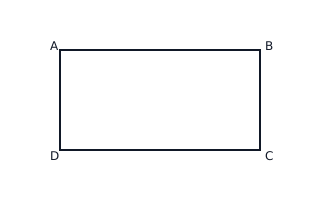
Relationship in Shapes: In polygons like rectangles, adjacent sides are intersecting (meeting at the vertex), while opposite sides are parallel.
📐Formulae
Notation for a line passing through points and :
Symbolic representation of parallel lines:
Intersection of two lines and at point :
Condition for Parallelism: If the distance between two lines and is at any point , and is constant for all , then .
💡Examples
Problem 1:
Look at a standard window frame with a cross-grid. Identify the types of lines formed by the wooden bars and name the relationship between the top horizontal bar and the bottom horizontal bar.
Solution:
- The vertical bars and horizontal bars meet at specific points, so they are intersecting lines.
- The top horizontal bar and the bottom horizontal bar run in the same direction and never meet, so they are parallel lines.
- Symbolically, if the top bar is and the bottom is , we write .
Explanation:
The problem applies the definitions of intersection (meeting at a point) and parallelism (never meeting) to a real-world object.
Problem 2:
If line intersects line at point , and line also passes through point , what is the special name given to these three lines?
Solution:
- Line and line share point .
- Line also shares point .
- Since three lines () all pass through the same common point , they are called concurrent lines.
Explanation:
By definition, when three or more lines intersect at the same single point, they are classified as concurrent.
Problem 3:
In the given figure of a rectangle , identify all pairs of parallel line segments and any two pairs of intersecting line segments.
Solution:
Parallel pairs: and . Intersecting pairs: at point , and at point .
Explanation:
In a rectangle, opposite sides never meet even if extended, hence they are parallel. Adjacent sides meet at the corners (vertices), making them intersecting lines.
Problem 4:
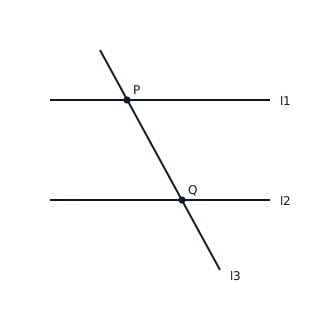
Observe the lines , , and . If is parallel to , and cuts across both, identify the points of intersection.
Solution:
The points of intersection are (where meets ) and (where meets ).
Explanation:
A line that intersects two or more lines is often called a transversal. Here, creates two distinct intersection points because and are separated by a constant distance.