
Review the key concepts, formulae, and examples before starting your quiz.
🔑Concepts
A quadrilateral is a polygon with four sides, four vertices, and four interior angles. It is named by listing its vertices in a cyclic order (either clockwise or counter-clockwise), such as .
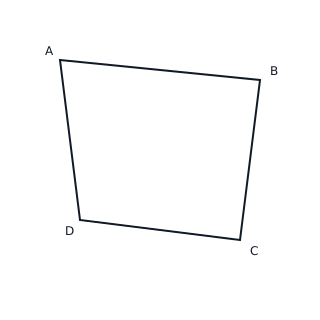
Two sides of a quadrilateral are called adjacent sides if they have a common endpoint. Two sides are called opposite sides if they do not have a common endpoint. In quadrilateral , and are adjacent, while and are opposite.
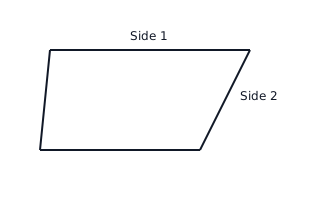
Diagonals are line segments connecting opposite vertices of a quadrilateral. Every quadrilateral has exactly two diagonals. For example, in , the diagonals are and .
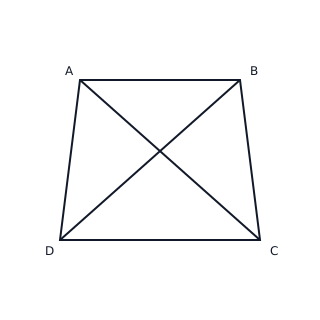
The interior of a quadrilateral is the region enclosed by its boundary. Any point lying inside this boundary is in the interior, while points on the edges are on the boundary, and points outside are in the exterior.
📐Formulae
Number of sides in a quadrilateral =
Number of vertices in a quadrilateral =
Number of diagonals in a quadrilateral =
Sum of interior angles of a quadrilateral =
Angle Sum Property:
💡Examples
Problem 1:
In a quadrilateral , the measures of three angles are , , and . Find the measure of the fourth angle .
Solution:
- We know the Angle Sum Property of a quadrilateral states:
- Substitute the given values:
- Add the known angles:
- Subtract from both sides:
Explanation:
To find the missing angle, we use the fact that the sum of all four interior angles in any quadrilateral must always equal .
Problem 2:
Given a quadrilateral with vertices in order, list all the pairs of opposite sides and all the pairs of adjacent angles.
Solution:
- Opposite Sides: These are sides that do not share a vertex. In , the pairs are ( and ) and ( and ).
- Adjacent Angles: These are angles that share a common side. The pairs are: (), (), (), and ().
Explanation:
Opposite sides are like the parallel or non-touching sides of a box. Adjacent angles are simply the corners that are next to each other along the same line segment.
Problem 3:
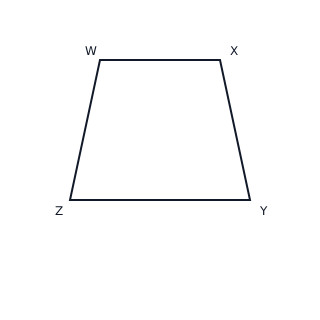
In the quadrilateral shown below, identify: (a) A pair of adjacent sides meeting at vertex , and (b) The two diagonals.
Solution:
(a) The sides meeting at vertex are and . Therefore, and are adjacent sides. (b) The diagonals are the segments joining opposite vertices, which are and .
Explanation:
Adjacent sides always share a common vertex. Diagonals connect vertices that are not next to each other.
Problem 4:
Calculate the missing angle in the quadrilateral where , , and .
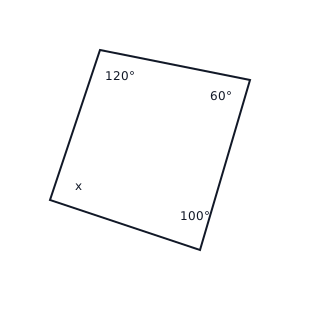
Solution:
The sum of the interior angles of a quadrilateral is . Sum of given angles = . . Therefore, .
Explanation:
We use the Angle Sum Property of a quadrilateral: .