
Review the key concepts, formulae, and examples before starting your quiz.
🔑Concepts
An angle is formed by two rays meeting at a common endpoint called the vertex. The rays are known as the arms of the angle.
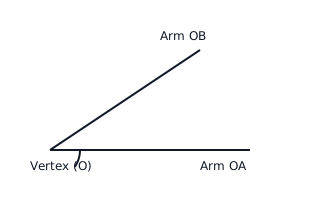
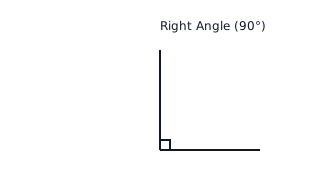
Angles are classified by their magnitude. An acute angle is less than , a right angle is exactly , and an obtuse angle is greater than but less than .
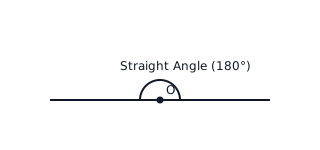
A straight angle measures exactly and forms a straight line. A reflex angle is greater than but less than .
A protractor is the standard tool used to measure angles in degrees (). It has two scales: an inner scale and an outer scale, used depending on the direction of the angle's arm.
📐Formulae
💡Examples
Problem 1:
Classify the following angles based on their measures: (a) , (b) , (c) , (d) .
Solution:
(a) is an Acute Angle because . (b) is an Obtuse Angle because . (c) is a Reflex Angle because . (d) is a Right Angle because it is exactly .
Explanation:
To classify angles, we compare the given degree measure against the standard definitions of acute, right, obtuse, and reflex angles.
Problem 2:
If a straight angle is divided into two parts, and one part measures , what is the measure of the other part?
Solution:
Step 1: We know that a straight angle measures . Step 2: Let the unknown angle be . Step 3: Set up the equation: . Step 4: Solve for : . Final Answer: The other part measures .
Explanation:
Since the total measure of a straight angle is a fixed value of , we subtract the known angle from to find the missing portion.
Problem 3:
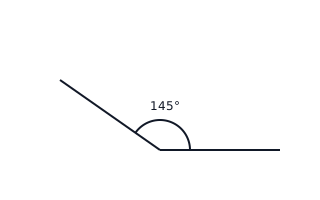
Identify the type of angle shown in the figure if its measure is .
Solution:
Explanation:
An angle that measures more than but less than is classified as an obtuse angle. Since , it is obtuse.
Problem 4:
Find the measure of the missing angle in the following figure, given that the total angle is a right angle.
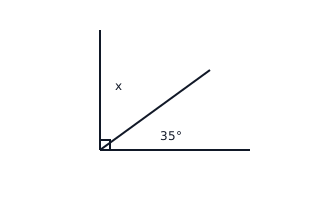
Solution:
Explanation:
A right angle measures . To find the value of , we subtract the known angle from . Thus, .