
Review the key concepts, formulae, and examples before starting your quiz.
🔑Concepts
A point represents a specific location in space and has no dimensions (length, breadth, or thickness). It is represented by a dot and named with a capital letter.

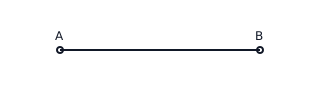
A line segment is a part of a line with two fixed endpoints. It has a definite length and can be measured.
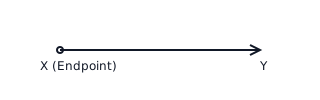
A ray is a part of a line that starts at one fixed point and extends infinitely in one direction. It has no definite length.
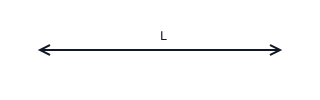
A line extends infinitely in both directions. It has no endpoints and no definite length.
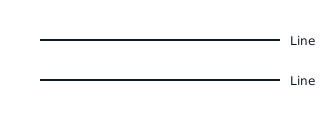
Parallel lines are lines on a flat surface that never meet, no matter how far they are extended. They always maintain a constant distance from each other.
📐Formulae
💡Examples
Problem 1:
A line segment is long. A point lies on the segment such that the length of is . Find the length of the segment .
Solution:
- We know that the total length of the segment is .
- The segment is divided into two parts: and .
- Therefore, .
- Substituting the known values: .
- To find , subtract from : .
Explanation:
This problem uses the property that the total length of a line segment is the sum of its parts when a point lies between the endpoints.
Problem 2:
Identify the following geometric figures: (i) A figure with two endpoints, (ii) A figure with one endpoint and one arrowhead, (iii) A figure with arrowheads at both ends.
Solution:
i. A figure with two fixed endpoints is a Line Segment, denoted as .\nii. A figure with one fixed endpoint and one arrowhead (extending infinitely) is a Ray, denoted as .\niii. A figure with arrowheads at both ends (extending infinitely in both directions) is a Line, denoted as .
Explanation:
This example tests the conceptual understanding of the physical characteristics and symbolic representations of lines, segments, and rays.
Problem 3:
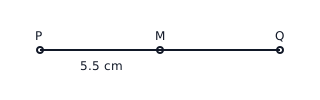
In the given figure, point is the midpoint of the line segment . If the length of , what is the total length of the segment ?
Solution:
Since is the midpoint, .
Explanation:
A midpoint divides a line segment into two equal parts. To find the total length, we multiply the length of one part by 2 or add the two equal parts together.
Problem 4:
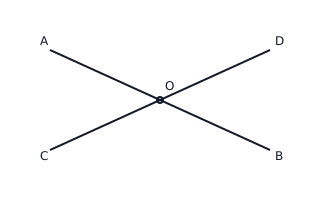
Observe the figure below. Name the intersecting lines and their point of intersection.
Solution:
The intersecting lines are and . The point of intersection is .
Explanation:
Intersecting lines are two lines that cross each other at exactly one common point, known as the point of intersection.