
Review the key concepts, formulae, and examples before starting your quiz.
🔑Concepts
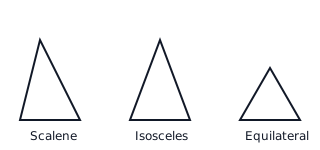
Triangles are classified based on the length of their sides: Scalene (all sides unequal), Isosceles (two sides equal), and Equilateral (all three sides equal).
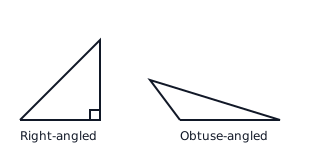
Triangles are also classified by their angles: Acute (all angles ), Right (one angle ), and Obtuse (one angle ).
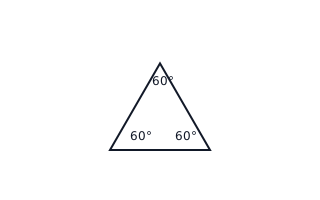
In an equilateral triangle, all three interior angles are equal, and each measures .
In an isosceles triangle, the angles opposite to the equal sides are also equal.
📐Formulae
Sum of interior angles:
Perimeter of a triangle: , where are the lengths of the sides.
Perimeter of an Equilateral triangle: , where is the length of one side.
Condition for a triangle: The sum of the lengths of any two sides must be greater than the length of the third side:
💡Examples
Problem 1:
In , and . Find the measure of and classify the triangle based on its angles.
Solution:
Step 1: Use the Angle Sum Property. .\nStep 2: Substitute the known values: .\nStep 3: Calculate the sum of the known angles: .\nStep 4: Solve for : .\nStep 5: Since all three angles () are less than , the triangle is an Acute-angled triangle.
Explanation:
To find a missing angle, subtract the sum of the known angles from . Once all angles are known, compare them to to classify the triangle.
Problem 2:
A triangle has side lengths of , , and . Classify this triangle based on its sides and calculate its perimeter.
Solution:
Step 1: Identify the side lengths: , , .\nStep 2: Observe that two sides are equal (). Therefore, the triangle is an Isosceles triangle.\nStep 3: Calculate the perimeter using the formula .\nStep 4: .
Explanation:
Classification by sides depends on how many sides have equal lengths. Since exactly two sides are the same, it is isosceles. The perimeter is simply the sum of all sides.
Problem 3:
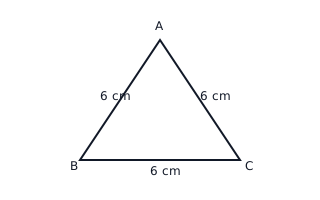
Identify the type of triangle where side , , and . Find its perimeter.
Solution:
Explanation:
A triangle with all three sides of equal length is called an equilateral triangle. The perimeter is the sum of all sides, which for an equilateral triangle is times the side length.
Problem 4:
In triangle , , , and . Classify the triangle based on its angles and find the third side if the perimeter is .
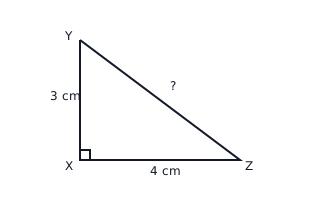
Solution:
Explanation:
The presence of a angle makes it a right-angled triangle. To find the missing side, subtract the sum of the known sides from the total perimeter.