
Review the key concepts, formulae, and examples before starting your quiz.
🔑Concepts
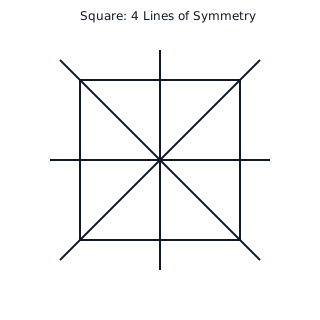
Reflectional symmetry, also known as line symmetry, occurs when a figure can be divided into two identical halves by a line called the axis of symmetry. Each point on one side of the line has a corresponding point on the other side at an equal distance.
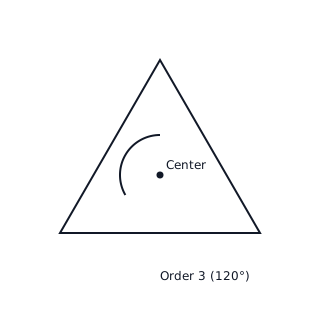
Rotational symmetry exists when a shape looks exactly the same after a rotation of less than about its center point. The number of times it matches itself in one full turn is called the order of rotational symmetry.
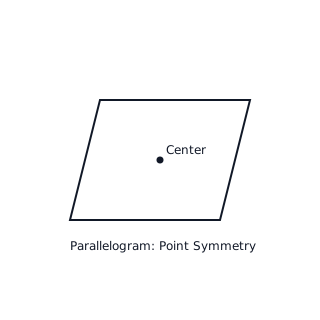
Point symmetry is a special type of rotational symmetry where a figure looks the same when rotated (a half-turn). This is also known as symmetry about the origin or center point.
Patterns in geometry often involve transformations such as sliding (translation), flipping (reflection), or turning (rotation). These transformations are used to create tessellations and tile designs.
Number patterns can be visualized using shapes. For example, triangular numbers are represented by dots arranged in an equilateral triangle, while square numbers are represented by dots in a square grid.
📐Formulae
💡Examples
Problem 1:
Determine the number of lines of symmetry in a regular pentagon and describe their positions.
Solution:
- A regular pentagon has sides of equal length.
- According to the rule for regular polygons, the number of lines of symmetry equals the number of sides ().
- In a pentagon, each line of symmetry starts from one vertex (corner) and passes through the midpoint of the opposite side.
- Therefore, there are exactly lines of symmetry.
Explanation:
For any regular polygon where all sides and angles are equal, the symmetry lines always match the count of the vertices or sides.
Problem 2:
Identify the pattern rule and find the next two terms in the sequence:
Solution:
- Look at the relationship between the first and second terms: .
- Check if the same rule applies to the next terms: and .
- The rule is 'Multiply the previous term by '.
- Calculate the next term: .
- Calculate the term after that: .
- The next two terms are and .
Explanation:
This is a geometric growth pattern where each number is scaled by a constant factor to find the subsequent value.
Problem 3:
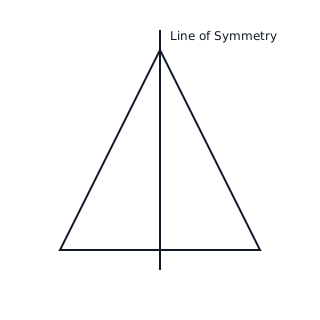
Identify the number of lines of symmetry in an isosceles triangle where only two sides are equal.
Solution:
An isosceles triangle with two equal sides has exactly line of symmetry.
Explanation:
The line of symmetry passes through the vertex between the equal sides and bisects the base. If we fold the triangle along this vertical line, the two halves will coincide exactly.
Problem 4:
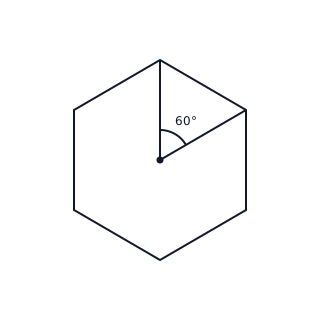
Calculate the angle of rotation for a regular hexagon to look the same for the first time after its initial position.
Solution:
The angle of rotation is .
Explanation:
A regular hexagon has equal sides and equal angles. Its order of rotational symmetry is . The angle is calculated as .