
Review the key concepts, formulae, and examples before starting your quiz.
🔑Concepts
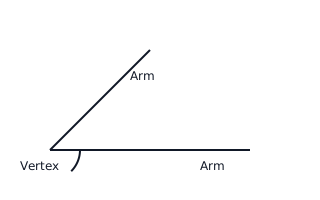
An angle is formed when two lines meet at a common point called the vertex. We measure angles in degrees using the symbol .
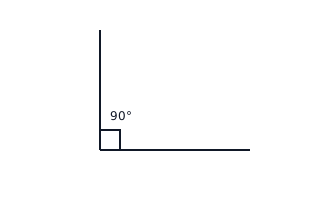
A Right Angle looks like the corner of a square or the letter 'L'. It measures exactly .
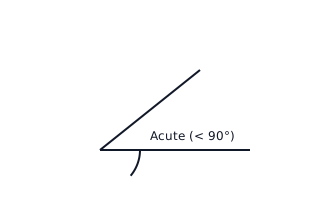
An Acute Angle is 'smaller' than a right angle. Its measure is always more than but less than .
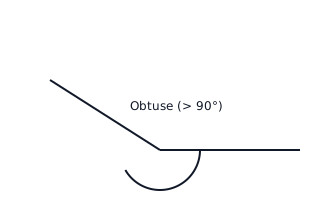
An Obtuse Angle is 'wider' than a right angle. Its measure is more than but less than .
📐Formulae
💡Examples
Problem 1:
Identify the type of angle for the following measurements: (a) , (b) , and (c) .
Solution:
Step 1: Compare to . Since , it is an Acute Angle. Step 2: Compare to and . Since , it is an Obtuse Angle. Step 3: is exactly the measurement of a Right Angle.
Explanation:
To classify angles, we use as the primary benchmark. Angles smaller than are acute, larger are obtuse, and exactly are right.
Problem 2:
If two angles are joined to form a right angle, and one of the angles is , what is the measure of the other angle?
Solution:
Step 1: Recall that a Right Angle is exactly . Step 2: Set up the equation: . Step 3: Subtract the known angle from the total: . The second angle is .
Explanation:
Since the combined shape is a right angle, the sum of its parts must equal . We use subtraction to find the missing part.
Problem 3:
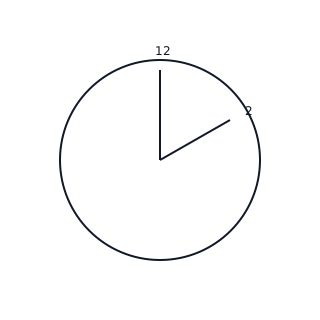
Look at the hands of the clock shown in the diagram. What type of angle is formed between the hour hand and the minute hand at 2 o'clock?
Solution:
The angle formed is an Acute Angle.
Explanation:
At 2 o'clock, the angle is smaller than a right angle (). Specifically, since each hour mark represents , the angle is , which is less than .
Problem 4:
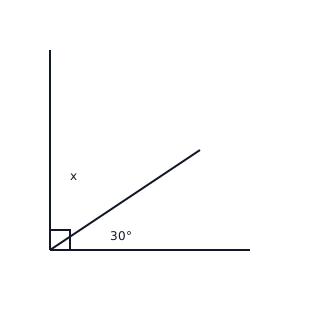
In the following figure, a large right angle is divided into two parts. If the measure of one part is , find the value of the angle marked as .
Solution:
Explanation:
The total angle is a right angle, which means its total measure is . We can set up the equation: . Subtracting from both sides, we get .