
Review the key concepts, formulae, and examples before starting your quiz.
🔑Concepts
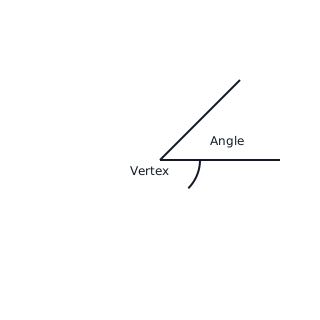
An angle is formed when two lines meet at a common point called the vertex. We measure the opening between these lines in degrees, denoted by the symbol . A full circle or a complete turn is .
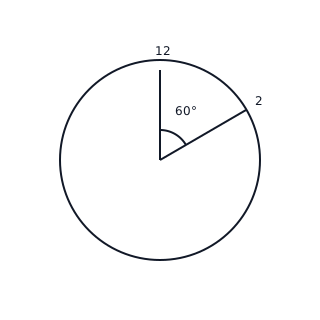
A Degree Clock uses the 12-hour clock face to help us understand angles. Since a full turn is and there are 12 divisions, each hour mark represents a jump (). For example, at 2 o'clock, the angle is .
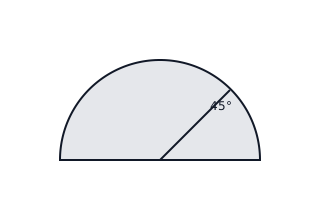
Angles are classified by their size: Acute angles are less than (like an L-shape closing), Right angles are exactly (like a perfect L-shape), and Obtuse angles are more than but less than (like an L-shape opening wider).
We use a protractor to measure angles precisely. The center of the protractor is placed on the vertex, and the base line is aligned with one arm of the angle. We read the degree where the second arm crosses the scale.
📐Formulae
💡Examples
Problem 1:
What is the measure of the angle formed by the hands of a clock at 3:00, and what type of angle is it?
Solution:
Step 1: A clock is divided into equal hour divisions. The total angle in a circle is . Step 2: Calculate the angle for one hour division: . Step 3: At 3:00, the minute hand is at and the hour hand is at . This is a gap of hours. Step 4: Multiply the hours by the angle per hour: .
Explanation:
Since the angle is exactly , it forms a right angle, resembling the corner of a square.
Problem 2:
If a degree clock shows a turn, calculate the angle in degrees and identify the type of angle.
Solution:
Step 1: A full turn in a degree clock is equal to . Step 2: To find a turn, multiply the fraction by the total degrees: . Step 3: .
Explanation:
The calculated angle is . Since is greater than but less than , it is classified as an obtuse angle.
Problem 3:
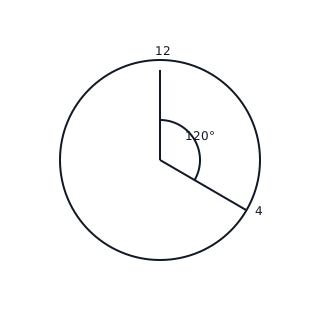
Calculate the angle between the hands of a clock when the time is exactly 4:00. What type of angle is this?
Solution:
- Each hour division on a clock represents .
- At 4:00, the minute hand is at 12 and the hour hand is at 4.
- The number of hour divisions between 12 and 4 is 4.
- Angle = .
Explanation:
Since the angle is greater than but less than , it is an obtuse angle.
Problem 4:
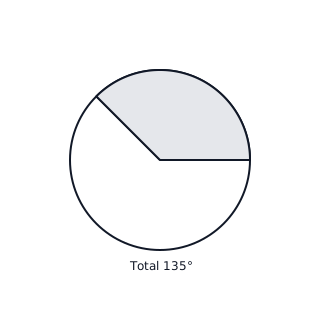
A fan rotates through a turn and then another turn. Calculate the total angle covered in degrees.
Solution:
- We know a full turn is .
- A turn = .
- A turn = .
- Total angle = .
Explanation:
We calculate the degree measure for each fraction of a full circle () and then add them together to find the total rotation.