
Review the key concepts, formulae, and examples before starting your quiz.
🔑Concepts
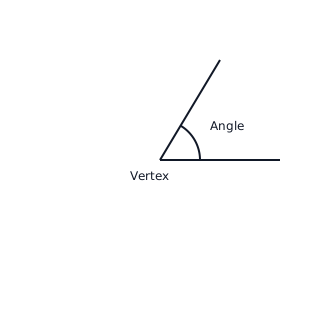
An angle is formed when two rays meet at a common endpoint called a vertex. The space between these rays is measured in degrees (). Basic types include acute (), right (), obtuse ( and ), and straight ().
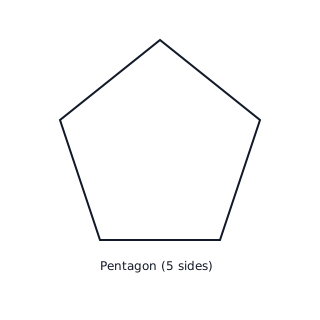
Closed shapes with straight sides are called polygons. The number of sides determines the name of the shape: 3 sides is a Triangle, 4 sides is a Quadrilateral (like squares or rectangles), 5 sides is a Pentagon, and 6 sides is a Hexagon.
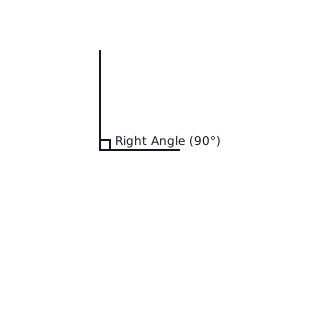
Angles in letters and numbers: Many capital letters and digits contain hidden angles. For example, the letter 'L' forms a (right) angle, while the letter 'V' forms an acute angle.
Changing shapes: Using flexible joints (like matchsticks and rubber tubes), you can see that changing the angles of a shape can change the shape itself without changing the side lengths. This is why triangles are used in bridges; they are the only polygon that does not change shape when pressed.
📐Formulae
Sum of interior angles of a triangle =
Sum of interior angles of a quadrilateral =
Sum of interior angles of a polygon with sides =
💡Examples
Problem 1:
In a triangle, two angles are and . Find the measure of the third angle.
Solution:
Step 1: Add the known angles: .\nStep 2: We know the sum of all angles in a triangle is .\nStep 3: Subtract the sum of the known angles from : .
Explanation:
Since the total sum of angles in any triangle must be , we find the missing value by subtracting the known parts from the total.
Problem 2:
A shape has four internal angles. Three of the angles are each. What is the value of the fourth angle, and what type of angle is it?
Solution:
Step 1: Identify the shape as a quadrilateral since it has 4 angles.\nStep 2: Calculate the sum of the three known angles: .\nStep 3: The total sum for a quadrilateral is . Subtract the known sum: .\nStep 4: An angle of is called a Right Angle.
Explanation:
We use the rule that a 4-sided shape's angles add up to to find the missing corner. Since the result is exactly , it is a right angle.
Problem 3:
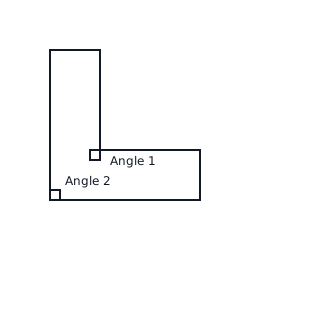
Identify the number of right angles in the given shape of a staircase step (a simple L-shaped polygon).
Solution:
The shape has 2 right angles.
Explanation:
Looking at the interior corners of the L-shape, there is one angle at the inner corner and another angle at the base. In this specific polygon, we count the corners that form a square shape.
Problem 4:
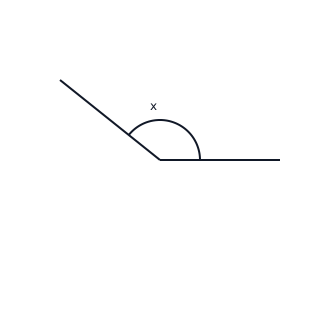
In the following figure, identify the type of angle marked as . Is it acute, obtuse, or a right angle?
Solution:
is an obtuse angle.
Explanation:
By observing the opening of the rays, the angle is clearly wider than a 'L' shape but smaller than a straight line. Therefore, it is an obtuse angle.