
Review the key concepts, formulae, and examples before starting your quiz.
🔑Concepts
An Angle Tester is a simple tool made of two strips (like cardboard or metal) joined at one end with a pivot (like a split pin). It can be opened to different widths to check if an angle is a right angle, less than a right angle, or more than a right angle.
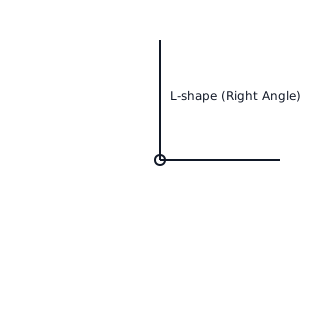
When the angle tester opens like the letter 'L', it is called a Right Angle. Its measure is exactly .
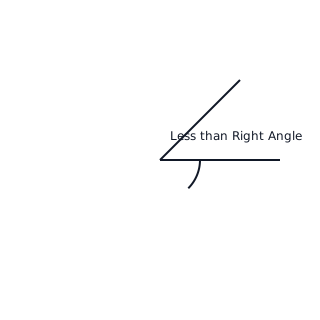
If the angle tester opens less than the 'L' shape, it is an Acute Angle, which is less than .
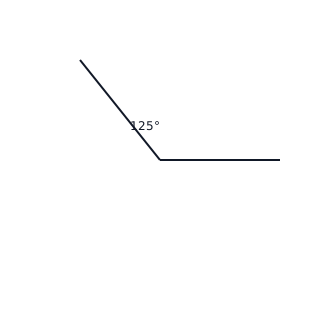
If the angle tester opens wider than the 'L' shape, it is an Obtuse Angle, which is more than but less than .
You can use the corner of your notebook or a square paper as a 'readymade' angle tester to check corners of objects around you.
📐Formulae
Right Angle =
Acute Angle <
Obtuse Angle > and <
Straight Angle =
Sum of angles in a triangle =
Sum of angles in a quadrilateral =
💡Examples
Problem 1:
A student uses an angle tester on the corner of a square window. The tester opens to form a perfect 'L' shape. What is the measurement and name of this angle?
Solution:
- The problem states the tester forms a perfect 'L' shape.
- By definition, an 'L' shape represents a Right Angle.
- A right angle always measures exactly .
Explanation:
We identify the angle by comparing the physical shape of the opening to the standard 'L' shape used in angle testers.
Problem 2:
If an angle is found to be smaller than a right angle, calculate its value and classify it.
Solution:
Step 1: Identify the value of a right angle: . Step 2: Subtract from the right angle: Step 3: Compare to . Since , the angle is an Acute Angle.
Explanation:
We use the fixed value of a right angle as a reference to find the unknown angle and then classify it based on whether it is smaller or larger than .
Problem 3:
Meena uses her angle tester on a pair of scissors. The blades are opened such that the tester shows an angle wider than an 'L' shape. If the angle is more than a right angle, what is its measure?
Solution:
Explanation:
A right angle is . Since the angle is 'more than a right angle' by , we add to to get . This is an obtuse angle.
Problem 4:
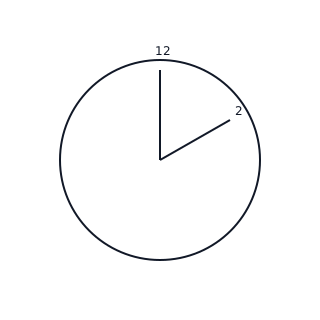
Look at the hands of a clock showing 2:00. Use your understanding of an angle tester to determine if the angle between the hands is a right angle, more than a right angle, or less than a right angle. Also, calculate the angle if each hour mark represents .
Solution:
It is less than a right angle.
Explanation:
At 2:00, the minute hand is at 12 and the hour hand is at 2. The gap covers 2 hour divisions. Since each hour is , the total angle is . Since , the angle tester would show it is less than an 'L' shape (acute).