
Review the key concepts, formulae, and examples before starting your quiz.
🔑Concepts
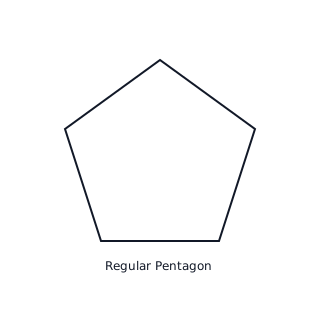
A polygon is a closed 2D shape with straight sides. Regular polygons have all sides equal and all interior angles equal. For a polygon with sides, the sum of interior angles is .
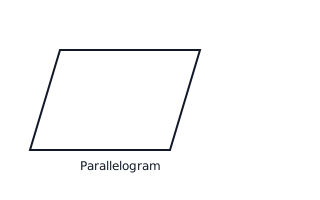
Quadrilaterals are four-sided polygons. Specific types include the Parallelogram (opposite sides parallel and equal), Rhombus (all sides equal, opposite sides parallel), and Trapezium (one pair of parallel sides).
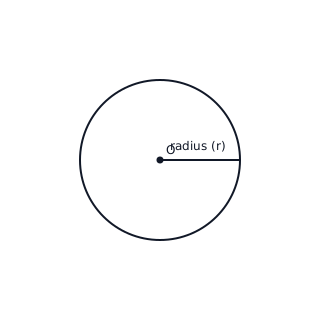
The circle is defined by its center and radius (). The distance across the circle through the center is the diameter (), where . The boundary length is called the circumference.
Triangles are classified by sides (Equilateral, Isosceles, Scalene) or by angles (Acute, Right-angled, Obtuse). The sum of angles is always .
📐Formulae
💡Examples
Problem 1:
A regular hexagon has one side length of 7 cm. What is its perimeter?
Solution:
42 cm
Explanation:
A hexagon has 6 sides. Since it is a 'regular' hexagon, all 6 sides are equal. Perimeter = .
Problem 2:
If the radius of a circle is 5.5 cm, calculate the diameter.
Solution:
11 cm
Explanation:
The diameter is always twice the length of the radius. Diameter = .
Problem 3:
In a right-angled triangle, one angle is and another is . Find the size of the third angle.
Solution:
45^{\circ}
Explanation:
The sum of angles in a triangle is . So, .
Problem 4:
Identify the quadrilateral that has two pairs of parallel sides, but no right angles and all four sides are equal.
Solution:
Rhombus
Explanation:
A square has four equal sides and right angles. A rhombus has four equal sides but its interior angles are not .
Problem 5:
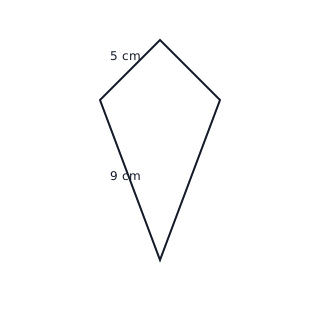
Calculate the perimeter of the following kite, where the short sides are and the long sides are .
Solution:
Explanation:
A kite has two pairs of adjacent sides that are equal in length. To find the perimeter, sum all four side lengths: .
Problem 6:
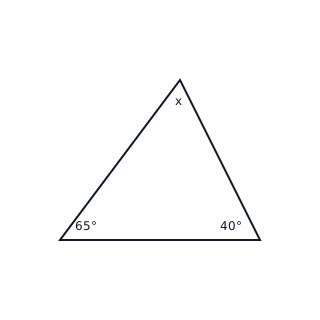
In the triangle shown, find the value of the missing angle .
Solution:
Explanation:
The sum of interior angles in any triangle is . Subtract the two known angles from to find the unknown third angle.