
Review the key concepts, formulae, and examples before starting your quiz.
🔑Concepts
3D shapes, or solids, are defined by three dimensions: length, width, and height. They are made up of faces (flat or curved surfaces), edges (where two faces meet), and vertices (points where edges meet).
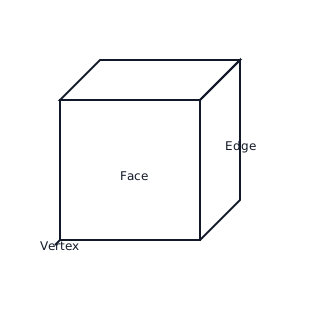
Prisms have two identical parallel bases and rectangular side faces. The name of the prism comes from the shape of its base (e.g., a Triangular Prism has triangular bases).
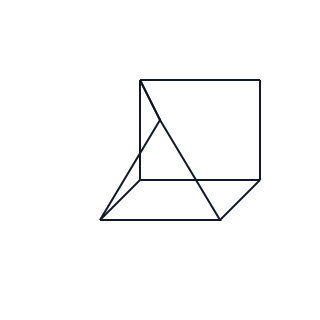
A net is a 2D pattern that can be folded to create a 3D shape. Every 3D shape can have multiple variations of its net, provided the faces align correctly when folded.
Pyramids have a base of any polygon and triangular faces that meet at a single point called the apex. A tetrahedron is a special pyramid with a triangular base.
📐Formulae
Euler's Formula (for shapes with flat faces):
Number of faces on a prism =
Number of faces on a pyramid =
💡Examples
Problem 1:
Identify the 3D shape that has 6 square faces, 12 edges, and 8 vertices. Draw its net.
Solution:
The shape is a Cube.
Explanation:
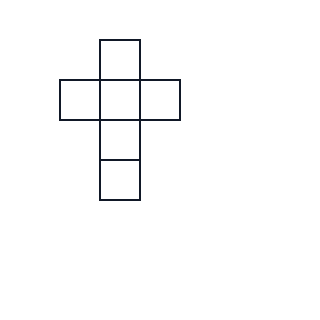
A cube is a special type of cuboid where all faces are equal squares. Its net consists of 6 squares arranged in a 'cross' or 'T' shape that can fold to join all edges.
Problem 2:
A shape has one circular base and one curved surface that meets at a point (apex). Name the shape and describe its net.
Solution:
The shape is a Cone.
Explanation:
A cone consists of a circle (the base) and a sector of a circle (the curved part). When the sector is wrapped around the circle, it forms the cone's point.
Problem 3:
Which 3D shape is formed by a net consisting of two identical triangles and three rectangles?
Solution:
Triangular Prism.
Explanation:
Prisms are named after their base. Since there are two triangles, these are the bases. The three rectangles connect the three sides of the triangles, forming a triangular prism.
Problem 4:
Count the faces, edges, and vertices of a Square-based Pyramid.
Solution:
Faces: 5, Edges: 8, Vertices: 5.
Explanation:
A square-based pyramid has 1 square base and 4 triangular faces (Total 5 faces). It has 4 edges around the base and 4 edges leading to the top (Total 8 edges). It has 4 corners at the base and 1 at the top (Total 5 vertices).
Problem 5:
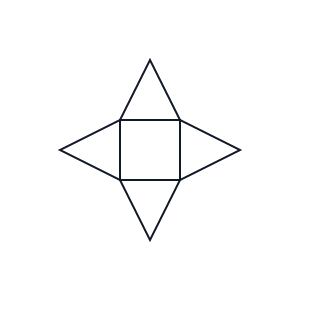
Identify the 3D shape that would be formed by folding the net shown below, which consists of one central square and four identical triangles attached to its sides.
Solution:
The shape is a Square-based Pyramid.
Explanation:
The central square acts as the base of the shape. When the four triangles are folded upward, their vertices meet at a single point (the apex), creating the four sloped faces of a pyramid.
Problem 6:
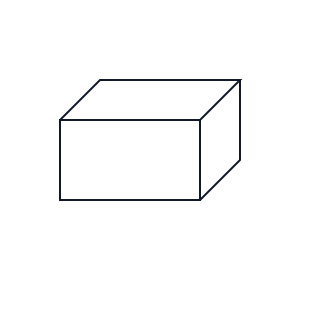
Identify the 3D shape represented by this drawing and state how many faces, edges, and vertices it has.
Solution:
The shape is a Cuboid (or Rectangular Prism).
- Faces:
- Edges:
- Vertices:
Explanation:
A cuboid has 6 rectangular faces. It follows Euler's formula: .