
Review the key concepts, formulae, and examples before starting your quiz.
🔑Concepts
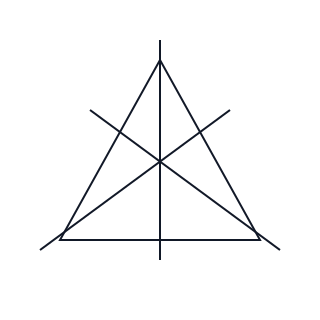
A line of symmetry is an imaginary line where you can fold a shape and have both halves match exactly. For a regular polygon, the number of lines of symmetry is equal to the number of sides. For example, a regular triangle has 3 lines of symmetry.
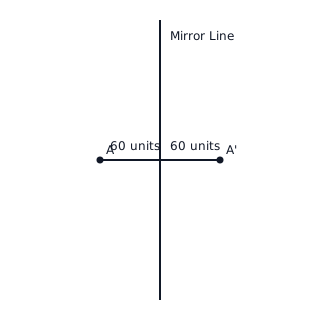
In a reflection, every point on the original object and its corresponding point on the image are equidistant from the mirror line. The line connecting a point to its image is perpendicular to the mirror line.
Reflection creates a lateral inversion. This means if you reflect an object in a vertical mirror line, the left and right sides are swapped. The size and shape (congruency) remain the same.
An object has rotational symmetry if it looks the same after a rotation of less than about its center. The number of times it looks the same during a full turn is called the order of rotational symmetry.
📐Formulae
💡Examples
Problem 1:
How many lines of symmetry does a non-square rectangle have?
Solution:
2 lines of symmetry.
Explanation:
A rectangle can be folded in half vertically and horizontally to match the sides perfectly. It cannot be folded diagonally because the corners will not meet.
Problem 2:
A point is 3 units to the left of a vertical mirror line. Where will its reflected image be located?
Solution:
3 units to the right of the mirror line.
Explanation:
In reflection, the image is always the same distance from the mirror line as the original object, but on the opposite side.
Problem 3:
Which of these capital letters have at least one line of symmetry: A, F, H, L?
Solution:
A and H.
Explanation:
Letter 'A' has one vertical line of symmetry down the middle. Letter 'H' has two: one vertical and one horizontal. 'F' and 'L' cannot be folded to match perfectly.
Problem 4:
How many lines of symmetry does a regular pentagon have?
Solution:
5 lines of symmetry.
Explanation:
Since a regular pentagon has 5 equal sides and 5 equal angles, it follows the rule that the number of lines of symmetry equals the number of sides. Each line runs from a vertex to the midpoint of the opposite side.
Problem 5:
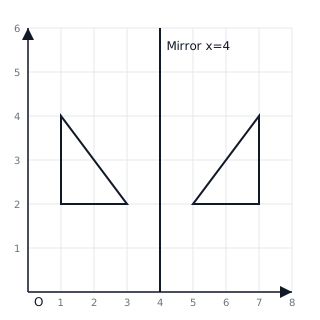
Reflect the triangle with vertices at , , and across the vertical line . What are the coordinates of the reflected image ?
Solution:
Explanation:
To reflect across , we find the horizontal distance from each point to the line and move the same distance to the other side. is units from the line, so is at . is unit from the line, so is at . is units from the line, so is at . The -coordinates remain unchanged.
Problem 6:
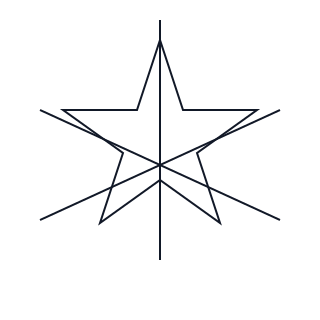
Identify the number of lines of symmetry in the following star shape (regular hexagram).
Solution:
Explanation:
A regular hexagram (six-pointed star) has 6 lines of symmetry: 3 lines passing through opposite pairs of points, and 3 lines passing through the opposite interior vertices (the 'valleys').