
Review the key concepts, formulae, and examples before starting your quiz.
🔑Concepts
The vertex of the angle must be perfectly aligned with the center point of the protractor. The base line of the angle must align with the line on the protractor scale.
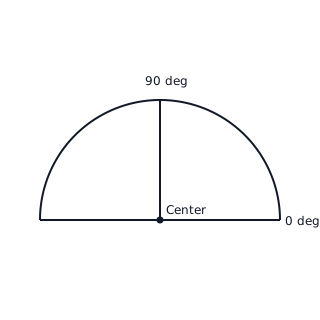
A protractor has two scales: an inner scale and an outer scale. Always start counting from on the side where the base arm of your angle lies. If the angle opens to the right, use the inner scale; if it opens to the left, use the outer scale.
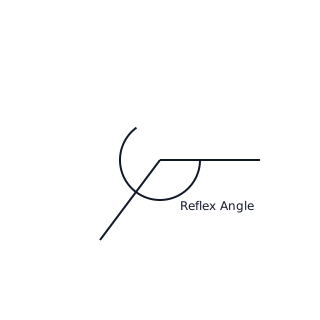
To draw a reflex angle (greater than but less than ), subtract the angle from . Draw the resulting small angle and the reflex angle is the space on the outside.
Estimating before measuring prevents scale errors. If an angle looks wide (obtuse), the measurement must be between and .
📐Formulae
💡Examples
Problem 1:
You are measuring an angle. You place the center of the protractor on the vertex and align the right arm of the angle with the 0° mark on the inner scale. The other arm points between 50 and 60, specifically at the 55 mark on the inner scale. What is the measurement?
Solution:
55°
Explanation:
Because the baseline arm aligned with the 0° on the inner scale, we must follow the inner scale to find the measurement. The arm points to 55°, which is an acute angle.
Problem 2:
Describe the steps to draw an angle of 130°.
Solution:
- Draw a straight horizontal line. 2. Mark a point (vertex) at the left end. 3. Place the protractor center on the vertex and the 0° line on the ray. 4. Using the scale starting at 0°, find 130° and make a dot. 5. Remove the protractor and join the vertex to the dot.
Explanation:
Since 130° is greater than 90°, the resulting angle should be obtuse (wider than a square corner).
Problem 3:
If an angle is measured using the wrong scale and the student reads 150°, but the angle is clearly acute, what is the correct measurement?
Solution:
30°
Explanation:
Standard protractors have scales that add up to 180° at any given point (). If the student read 150° (obtuse) but the angle is acute, they likely looked at the wrong scale. The corresponding measurement on the opposite scale is 30°.
Problem 4:
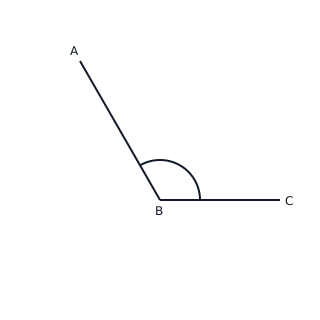
Identify the measurement of the angle shown in the diagram, where point is the vertex and the base lies on the right-side zero line.
Solution:
The angle measures .
Explanation:
- Place the protractor center on point .
- Align line with the mark on the inner scale.
- Follow the inner scale around to where line crosses it.
- The line points exactly at on the inner scale. Since the angle is obtuse, is the correct reading.
Problem 5:
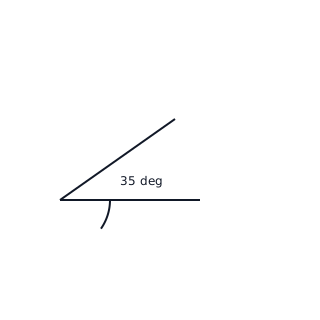
Draw an acute angle of using a ruler and a protractor.
Solution:
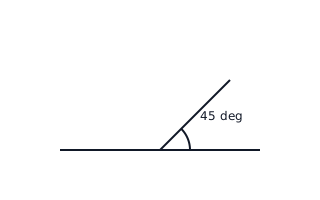
The resulting drawing shows two lines meeting at a point with a gap of .
Explanation:
- Use a ruler to draw a horizontal baseline.
- Place the protractor center at the left end of the line.
- Mark a dot at the mark on the outer scale (starting from 0 on the left).
- Remove the protractor and use the ruler to connect the endpoint of the baseline to the dot.