
Review the key concepts, formulae, and examples before starting your quiz.
🔑Concepts
An angle is formed when two rays meet at a common endpoint called the vertex. The rays are known as the arms of the angle.
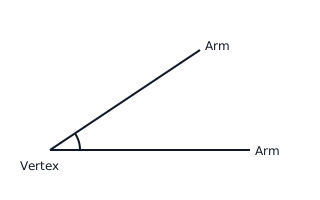
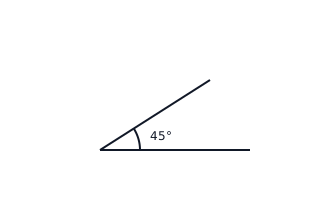
An Acute Angle measures more than but less than . It looks like a partially open pair of scissors.
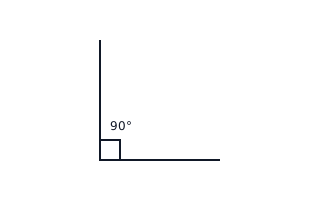
A Right Angle measures exactly . It forms an 'L' shape and is often marked with a small square at the vertex.
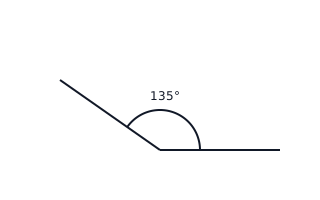
An Obtuse Angle measures more than but less than . It is wider than a right angle.
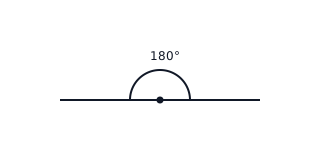
A Straight Angle measures exactly . It appears as a straight line.
📐Formulae
💡Examples
Problem 1:
Classify the following angles based on their degree measures: (a) , (b) , (c) .
Solution:
Step 1: Check . Since is greater than and less than , it is an Acute Angle. Step 2: Check . Since is greater than and less than , it is an Obtuse Angle. Step 3: Check . Since it is exactly , it is a Right Angle.
Explanation:
To identify an angle, compare the given measure against the standard benchmarks: (Right) and (Straight).
Problem 2:
What type of angle is formed if you add to a angle? Show the calculation.
Solution:
Step 1: Find the total measure by adding the two angles: . Step 2: Identify the type of angle that measures exactly . The result is a Right Angle.
Explanation:
First, calculate the sum of the angles. Then, use the definition of a right angle () to classify the result.
Problem 3:
Look at the clock face where the hour hand is at 12 and the minute hand is at 4. What is the type of angle formed between the two hands if the angle measure is ?
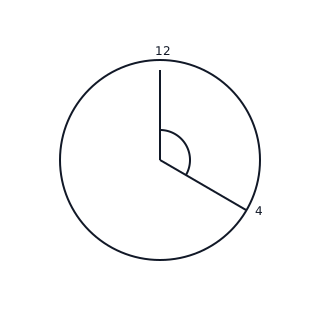
Solution:
Since , the angle is an obtuse angle.
Explanation:
Any angle that measures more than but less than is classified as an obtuse angle.
Problem 4:
A carpenter cuts a piece of wood at an angle of . Identify the type of angle and show it in relation to a corner.
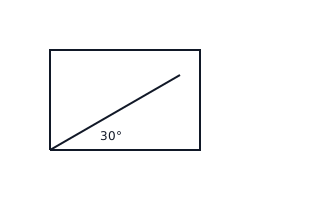
Solution:
Since , it is an acute angle.
Explanation:
Angles smaller than a right angle () are called acute angles.