
Review the key concepts, formulae, and examples before starting your quiz.
🔑Concepts
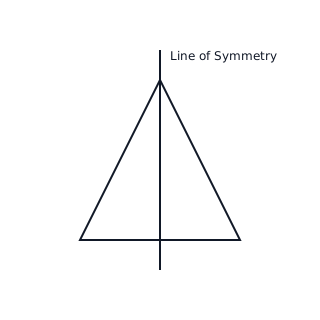
Symmetry exists when one shape becomes exactly like another if you flip, slide or turn it. The imaginary line where you could fold the image and have both halves match exactly is called the Line of Symmetry.
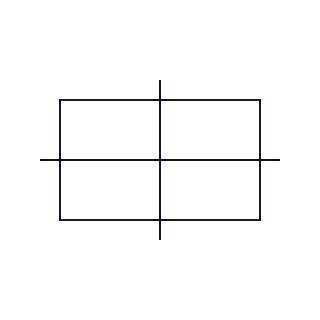
A Rectangle has lines of symmetry: one horizontal and one vertical. Unlike a square, the diagonals of a rectangle are not lines of symmetry because folding along them does not align the corners.
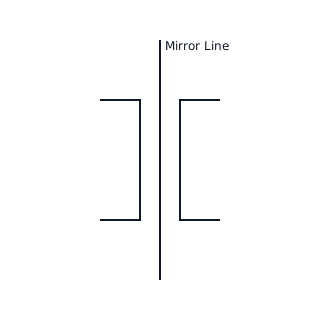
Reflection symmetry creates a 'mirror image'. In a reflection, every point of the original object is at the same distance from the mirror line as the corresponding point of the reflected image.
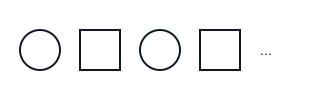
Patterns are sequences that repeat based on a specific rule. Geometric patterns often involve shapes rotating, changing size, or alternating in a predictable way.
📐Formulae
(where is the number of sides)
(Infinite lines passing through the center)
💡Examples
Problem 1:
Determine the number of lines of symmetry for a regular hexagon and describe where they are located.
Solution:
Step 1: Identify the number of sides in a regular hexagon. A hexagon has sides. Step 2: Use the rule for regular polygons, which states that the number of lines of symmetry equals the number of sides. Step 3: Count the lines. There are lines passing through the opposite vertices (corners) and lines passing through the midpoints of opposite sides. Total lines of symmetry = .
Explanation:
Since a regular hexagon has equal sides and angles, any line passing through the center to opposite vertices or midpoints will divide it into two identical halves.
Problem 2:
Identify the rule and find the next two terms in the pattern:
Solution:
Step 1: Look at the relationship between the first and second terms: . Step 2: Check if this rule applies to the rest: and . The rule is 'multiply by '. Step 3: Calculate the next term: . Step 4: Calculate the term after that: . The next two terms are and .
Explanation:
This is a growing pattern where each subsequent number is double the previous number.
Problem 3:
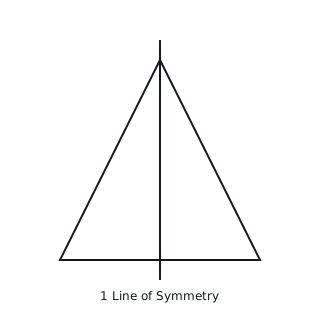
Identify the number of lines of symmetry in an isosceles triangle where only two sides are equal.
Solution:
An isosceles triangle has line of symmetry.
Explanation:
In an isosceles triangle, only the line passing through the vertex between the equal sides and the midpoint of the opposite base divides it into two identical halves. Lines through the other vertices do not result in matching halves because the side lengths are unequal.
Problem 4:
Complete the following number pattern and identify the rule:

Solution:
The next two terms are and . The rule is 'Add '.
Explanation:
Check the difference between consecutive terms: Since the difference is constant, we add to the last term to find the next: