
Review the key concepts, formulae, and examples before starting your quiz.
🔑Concepts
A net is a 2D flat shape that can be folded to make a 3D solid. Imagine unfolding a cardboard box; the flattened shape you see is the net of that box.
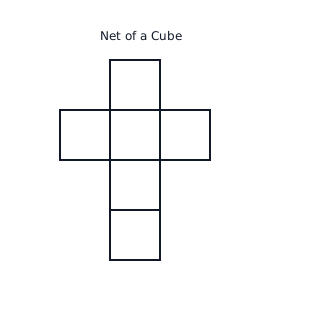
A net for a cuboid consists of rectangles. In opposite pairs, these rectangles must be identical to form the parallel faces of the 3D shape.
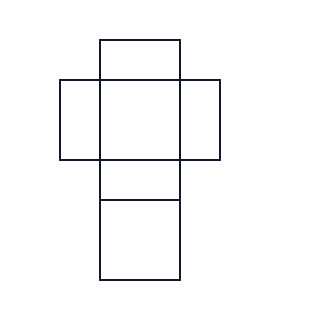
A triangular prism net is made of triangles (the bases) and rectangles (the lateral faces). The sides of the triangles must match the widths of the rectangles.
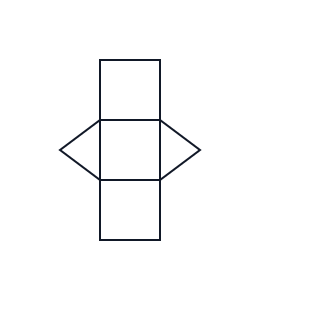
A square pyramid net has one square base in the center and four triangles attached to its sides which meet at a single point when folded.
📐Formulae
💡Examples
Problem 1:
A net is made up of identical circles and rectangle. Which 3D shape will be formed when this net is folded?
Solution:
Step 1: Identify the components of the net. We have circles and rectangle. Step 2: Recall the properties of 3D shapes. A shape with two circular bases and a curved surface (which unfolds into a rectangle) is a cylinder. Step 3: Therefore, the shape is a Cylinder.
Explanation:
In a cylinder net, the two circles represent the top and bottom faces, while the rectangle represents the curved side that wraps around the circles.
Problem 2:
Can a net with squares be used to fold a complete cube? Why or why not?
Solution:
Step 1: Count the number of faces in the given net. The count is . Step 2: Determine how many faces a cube has. A cube has faces. Step 3: Compare the numbers. Since , the net is missing one face. Conclusion: No, it cannot form a complete cube.
Explanation:
A complete cube requires square faces to close all sides. A net with only squares would result in an 'open' box with one side missing.
Problem 3:
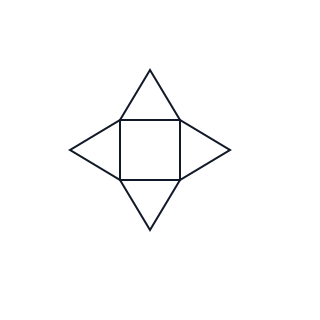
Identify the 3D shape that can be formed from a net consisting of one square and four equilateral triangles attached to its sides.
Solution:
The shape is a Square Pyramid.
Explanation:
A square pyramid has faces: square base and triangular faces that meet at a vertex. The net described perfectly matches these components.
Problem 4:
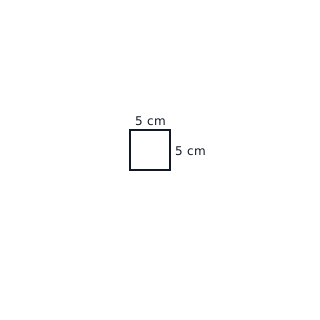
Calculate the total surface area of a cube if its net is made of six squares, each with a side length of .
Solution:
Explanation:
A cube has identical faces. Since the net is made of squares of side each, we find the area of one face and multiply by .