
Review the key concepts, formulae, and examples before starting your quiz.
🔑Concepts
A line of symmetry is an imaginary line that passes through the center of a shape or object and divides it into two identical halves. If you fold the shape along this line, both parts will overlap exactly.
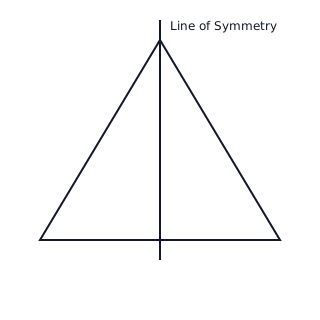
Shapes can have different types of symmetry: vertical, horizontal, or diagonal. A shape like a square possesses all three types.
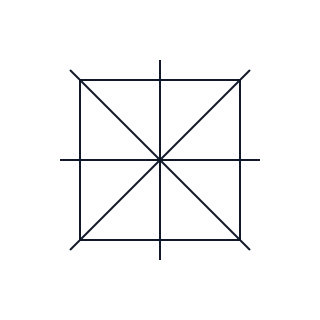
For regular polygons, the number of lines of symmetry is always equal to the number of sides. For example, a regular pentagon has lines of symmetry.
Some shapes, like an irregular scalene triangle or a parallelogram (that is not a rhombus), have zero lines of symmetry because no line can divide them into mirror images.
📐Formulae
💡Examples
Problem 1:
Determine how many lines of symmetry a regular hexagon has and describe where they are located.
Solution:
- Identify the shape: A regular hexagon has equal sides and equal angles.
- Apply the rule: For regular polygons, the number of lines of symmetry equals the number of sides. Therefore, it has lines of symmetry.
- Describe locations: lines pass through the opposite vertices (corners), and lines pass through the midpoints of the opposite sides.
Explanation:
Since the hexagon is 'regular,' we use the side-count property. By drawing lines from corner to corner and side-center to side-center, we find all ways to fold the shape into matching halves.
Problem 2:
A student thinks that a standard non-square rectangle has lines of symmetry because they counted the diagonals. Is the student correct? Explain why or why not.
Solution:
- Analyze the horizontal and vertical folds: Folding a rectangle vertically or horizontally through the center results in matching halves ( lines).
- Analyze the diagonal fold: If you fold a rectangle along a diagonal, the vertices (corners) do not meet. One corner will stick out past the other.
- Conclusion: The student is incorrect. A rectangle has only lines of symmetry.
Explanation:
To be a line of symmetry, the fold must result in a perfect overlap. While a diagonal divides a rectangle into two triangles of equal area, they are not mirror images in their current position, so the diagonal is not a line of symmetry.
Problem 3:
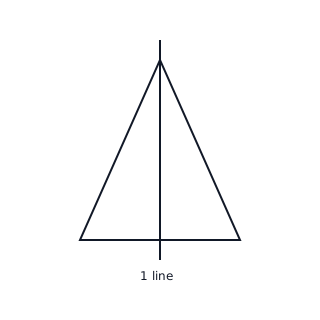
Identify the number of lines of symmetry in an isosceles triangle where two sides are equal.
Solution:
An isosceles triangle has line of symmetry.
Explanation:
In an isosceles triangle, only one line can be drawn from the vertex between the two equal sides to the midpoint of the base. This line creates two mirror-image right-angled triangles.
Problem 4:
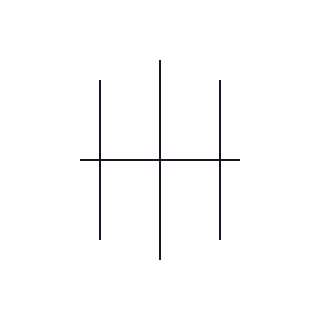
Look at the letter 'H'. How many lines of symmetry does it have?
Solution:
lines of symmetry.
Explanation:
The letter 'H' can be split perfectly by a vertical line down the center and a horizontal line across the middle bar.