
Review the key concepts, formulae, and examples before starting your quiz.
🔑Concepts
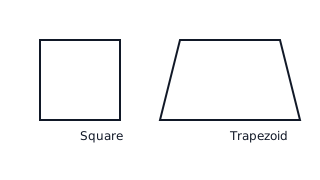
2D shapes, or polygons, are flat figures with sides and vertices. A quadrilateral is a 2D shape with exactly 4 sides and 4 vertices. Common quadrilaterals include the square, rectangle, rhombus, and trapezoid.
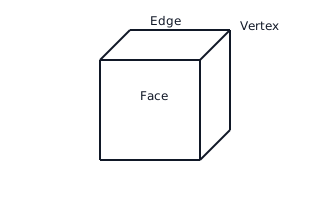
3D shapes are solid objects with three dimensions: length, width, and height. They are made up of faces (flat surfaces), edges (where two faces meet), and vertices (corners where edges meet).
Triangles can be classified by their sides: Equilateral (all sides equal), Isosceles (two sides equal), or Scalene (no sides equal).
A circle is a round 2D shape where every point on the edge is the same distance from the center. This distance is called the radius (), and the distance across the center is the diameter ().
📐Formulae
Perimeter of a Rectangle: where is length and is width
Perimeter of a Square: where is the side length
Area of a Rectangle:
Area of a Square: or
Euler's Rule for Polyhedra (Simple 3D shapes): where is faces, is vertices, and is edges
💡Examples
Problem 1:
A 3D shape has 1 square base and 4 triangular faces. Identify the shape and calculate the total number of edges and vertices.
Solution:
- Identify the shape: A shape with a square base and triangular faces meeting at a point is a Square-based Pyramid.
- Count Vertices (): There are vertices at the corners of the square base and vertex at the top (apex). Total .
- Count Edges (): There are edges around the square base and edges leading from the base to the apex. Total .
Explanation:
By visualizing the base and how the side faces connect to the top point, we can count the components of the pyramid systematically.
Problem 2:
Calculate the perimeter of a rectangle that has a length of and a width of .
Solution:
- Use the formula for the perimeter of a rectangle: .
- Substitute the given values: .
- Add the numbers inside the parentheses: .
- Multiply by : .
Explanation:
The perimeter is the total distance around the outside of the 2D shape, found by adding all four sides together.
Problem 3:
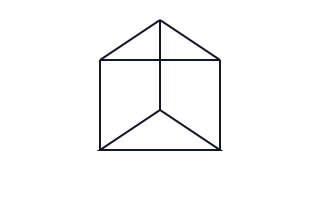
Identify the properties of a triangular prism. How many faces, edges, and vertices does it have?
Solution:
A triangular prism has:
- Faces: ( triangular bases and rectangular sides)
- Edges:
- Vertices:
Explanation:
You can count the parts by looking at the top and bottom triangles (3 edges each) and the 3 vertical lines connecting them. Euler's rule confirms this: .
Problem 4:
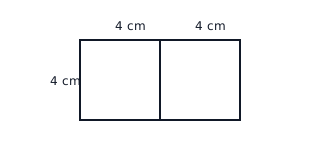
A compound shape is made by joining two squares of side side-by-side to form a rectangle. Find the perimeter of the resulting shape.
Solution:
Explanation:
When two squares are joined, the new length is . The width remains . The perimeter is the sum of all outer sides: .