
Review the key concepts, formulae, and examples before starting your quiz.
🔑Concepts
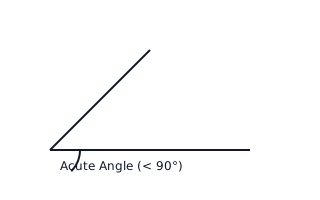
An acute angle is a 'sharp' angle that measures less than . It is smaller than a right angle (the corner of a square). Examples include , , and .
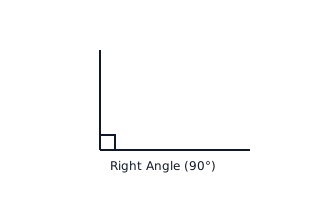
A right angle measures exactly . It looks like the corner of a sheet of paper or the letter 'L'. We often mark it with a small square at the vertex.
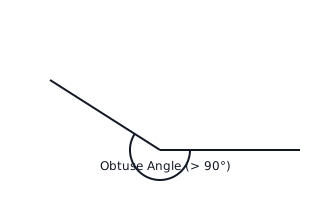
An obtuse angle is a 'blunt' angle that is greater than but less than . It is wider than a right angle.
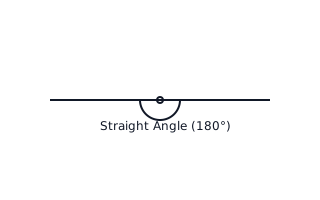
A straight angle measures exactly . It looks like a perfectly straight horizontal or vertical line and is equal to two right angles put together.
📐Formulae
💡Examples
Problem 1:
Look at a clock showing the time 2:00. What type of angle is formed between the hour hand and the minute hand? Calculate the degree measure if each hour represents .
Solution:
Step 1: Identify the positions of the hands. At 2:00, the minute hand is on 12 and the hour hand is on 2. Step 2: Calculate the degrees. Since there are 2 hour gaps between 12 and 2, the calculation is . Step 3: Compare with . Because is less than , it is an acute angle.
Explanation:
We use the benchmark of (a right angle) to classify the angle. Since is smaller than a square corner, it must be acute.
Problem 2:
An angle measures . Classify this angle as acute, right, obtuse, or straight, and describe its visual appearance compared to a right angle.
Solution:
Step 1: Check if the angle is . , so it is not a right angle. Step 2: Check if it is . , so it is not a straight angle. Step 3: Compare to and . Since , the angle is obtuse.
Explanation:
An obtuse angle is wider than a right angle () but hasn't yet reached a flat line (). Visually, it looks like a wide-open corner.
Problem 3:
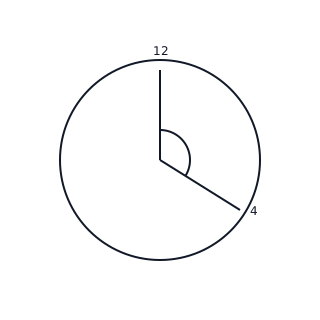
Identify the type of angle formed by the hands of a clock when it is exactly 4:00. Given that each hour mark on the clock represents , calculate the exact angle measure.
Solution:
- At 4:00, the minute hand is on 12 and the hour hand is on 4.
- The number of hour gaps between 12 and 4 is units.
- Since each unit is , the total angle is .
- Because is greater than but less than , it is an obtuse angle.
Explanation:
We count the intervals between the clock hands and multiply by the degrees per interval to find the total rotation, then classify it based on the four main categories.
Problem 4:
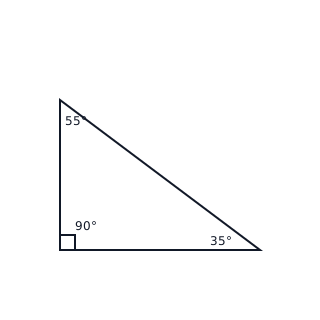
Consider a triangle where one angle is and another is . Find the third angle and classify it. (Note: The sum of angles in a triangle is )
Solution:
- Sum of known angles: .
- Third angle: .
- An angle that measures is a right angle.
Explanation:
By using the property that all internal angles of a triangle add up to 180 degrees, we find the missing value and recognize it as the standard measure for a right angle.