
Review the key concepts, formulae, and examples before starting your quiz.
🔑Concepts
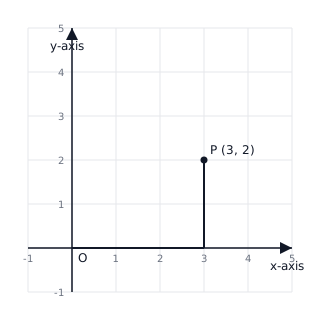
The coordinate plane is a 2D surface defined by two perpendicular lines: the horizontal -axis and the vertical -axis. The point where they intersect is called the origin, written as . Each point is identified by an ordered pair . To plot a point, always move along the -axis first, then up along the -axis.
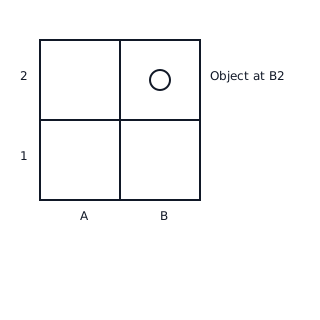
Grid references are often used on maps to identify squares instead of exact points. In a grid system, letters usually denote columns (horizontal) and numbers denote rows (vertical). For example, a square might be labeled .
Translation means sliding a shape or point to a new position without rotating it or changing its size. To translate a point, you add or subtract from its coordinates. Moving left/right affects the -coordinate; moving up/down affects the -coordinate.
The four quadrants: Grade 4 usually focuses on the first quadrant where both and are positive. In this area, we always work within the space to the right of and above the origin.
📐Formulae
Coordinate Format: where = horizontal distance and = vertical distance
Horizontal Translation: for moving units right
Vertical Translation: for moving units up
Origin:
💡Examples
Problem 1:
Identify the coordinates of a point that is units to the right of the origin and units above the origin.
Solution:
Step 1: Start at the origin . Step 2: Move units to the right along the x-axis to reach . Step 3: Move units up parallel to the y-axis to reach . Step 4: Combine the numbers into an ordered pair: .
Explanation:
The horizontal distance is the first number in the pair, and the vertical distance is the second number.
Problem 2:
A square has a vertex at . If you move this vertex units to the right and units up, what are the new coordinates?
Solution:
Step 1: Identify the initial and values: . Step 2: Add the horizontal movement to : . Step 3: Add the vertical movement to : . Step 4: The new coordinate is .
Explanation:
Translating a point involves adding or subtracting from the original coordinates based on the direction of movement.
Problem 3:
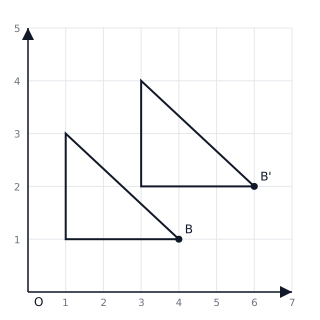
A triangle has vertices at , , and . If the entire triangle is translated units to the right and unit up, what are the new coordinates of vertex ?
Solution:
The new coordinates of vertex are .
Explanation:
To find the new position, take the original coordinates of . Add to the -coordinate () and add to the -coordinate ().
Problem 4:
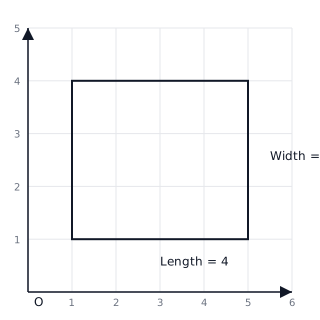
Find the area of a rectangle whose corners are at , , , and by calculating the length and width from the coordinates.
Solution:
Explanation:
Length = difference in -coordinates: units. Width = difference in -coordinates: units. .