
Review the key concepts, formulae, and examples before starting your quiz.
🔑Concepts
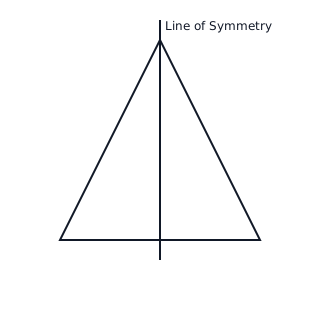
Line symmetry occurs when a shape can be folded along a straight line so that the two halves match exactly. This line is often called an 'axis of symmetry'.
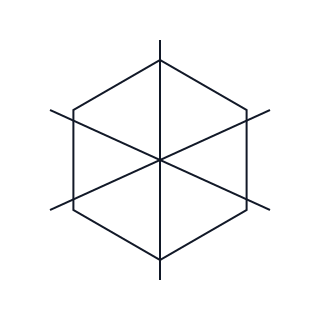
Regular polygons are shapes where all sides and angles are equal. A regular polygon has a number of lines of symmetry equal to its number of sides . For example, a regular hexagon has 6 lines of symmetry.
Reflective symmetry means that one half of the shape is a mirror image of the other. The distance from any point on the shape to the line of symmetry is equal to the distance from its corresponding 'mirror' point to the same line.
Quadrilaterals vary in symmetry: a square has 4 lines, a rectangle has 2, a rhombus has 2, and a kite has 1. A general scalene triangle or a general trapezium has 0 lines of symmetry.
📐Formulae
Rule for Regular Polygons: Number of lines of symmetry = Number of sides (e.g., a regular pentagon has 5 lines of symmetry).
Congruency Rule: The two parts created by a line of symmetry must be congruent (identical in shape and size).
💡Examples
Problem 1:
How many lines of symmetry does a square have?
Solution:
4 lines of symmetry.
Explanation:
A square can be folded vertically (1), horizontally (1), and diagonally from both sets of corners (2), making a total of 4 lines.
Problem 2:
Does the letter 'M' have a vertical or horizontal line of symmetry?
Solution:
Vertical line of symmetry.
Explanation:
If you draw a line straight down the middle of the 'M', the left side is a mirror image of the right side.
Problem 3:
Which shape has more lines of symmetry: a rectangle or a circle?
Solution:
A circle.
Explanation:
A rectangle has only 2 lines of symmetry (vertical and horizontal). A circle has an infinite (unlimited) number of lines of symmetry because any line passing through its center divides it into two equal halves.
Problem 4:
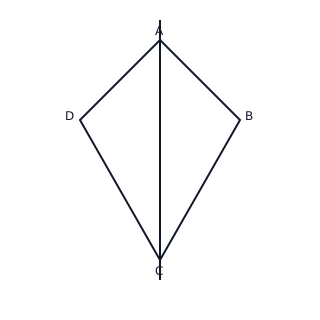
Identify the number of lines of symmetry in the following kite-shaped figure where and .
Solution:
1 line of symmetry.
Explanation:
A kite has only one line of symmetry. This line passes through the vertices between the pairs of equal sides (from to ). If you fold the kite along the line , the vertex will land exactly on vertex .
Problem 5:
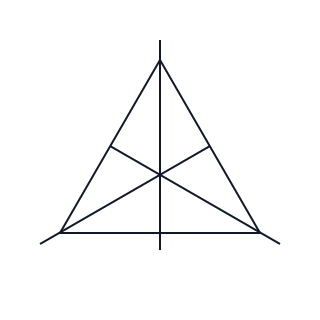
An equilateral triangle has sides of length . How many lines of symmetry can be drawn, and where do they pass through?
Solution:
3 lines of symmetry.
Explanation:
In an equilateral triangle, each line of symmetry passes through one vertex and the midpoint of the opposite side. Since there are 3 vertices, there are 3 such lines.