
Review the key concepts, formulae, and examples before starting your quiz.
🔑Concepts
A polygon is a 2D closed shape with straight sides. A regular polygon has all sides equal and all angles equal, whereas an irregular polygon has sides or angles of different sizes.
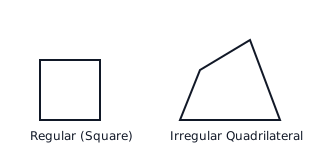
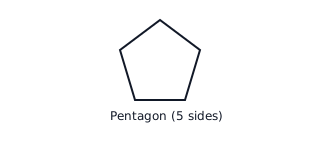
Polygons are named based on their number of sides: Triangle (3), Quadrilateral (4), Pentagon (5), Hexagon (6), Heptagon (7), and Octagon (8).
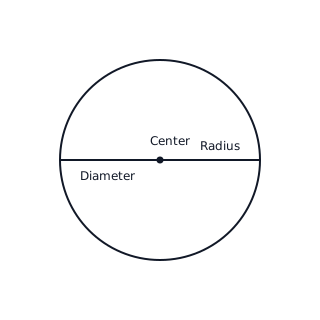
The parts of a circle include the center, the radius (distance from center to edge), the diameter (line across through the center), and the circumference (the boundary).
A quadrilateral is any four-sided polygon. Common types include the square, rectangle, rhombus, and trapezoid. Each has unique properties regarding parallel lines and side lengths.
📐Formulae
Perimeter of a polygon =
Number of vertices =
💡Examples
Problem 1:
A shape has 6 straight sides of equal length. What is the name of this shape, and is it regular or irregular?
Solution:
Regular Hexagon
Explanation:
A six-sided polygon is called a hexagon. Because all sides are mentioned as being equal in length, it is classified as 'regular'.
Problem 2:
If the radius of a circle is , what is the length of its diameter?
Solution:
Explanation:
The diameter of a circle is always twice the length of the radius. So, .
Problem 3:
A rectangle has two sides that are long and two sides that are long. Calculate the perimeter.
Solution:
Explanation:
The perimeter is the total distance around the shape. .
Problem 4:
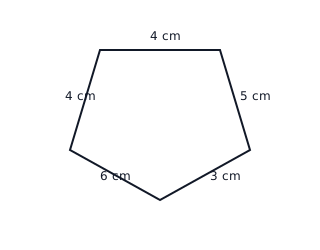
Calculate the perimeter of the irregular pentagon shown in the diagram, where the side lengths are , , , , and .
Solution:
Explanation:
To find the perimeter of any polygon, we add the lengths of all its outer sides together.
Problem 5:
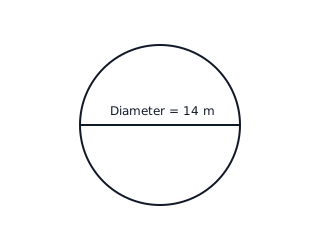
The diameter of a circular pond is . What is the radius of the pond?
Solution:
Explanation:
The radius is exactly half the length of the diameter, as it only goes from the center to the edge.